
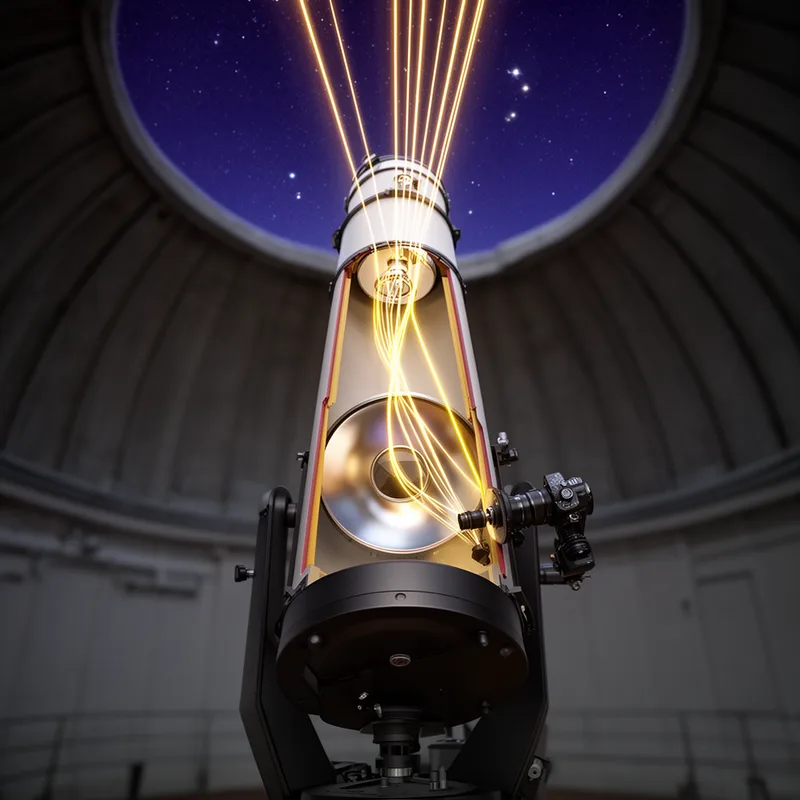
Cassegrainian telescope
- noun
- /ˈkæsəˌɡreɪniən tɛlɪˌskoʊp/
- Specialized
- The Cassegrainian telescope design allows for a much more compact instrument compared to traditional refractors.
Examples
-
Many astronomers prefer using a Cassegrainian telescope for deep-sky observations.
-
A Cassegrainian telescope is ideal for both amateur and professional astronomical observations.
-
Astronomers prefer a Cassegrainian telescope for its clear central field and ease of use.
-
The Cassegrainian telescope offers excellent image quality.
-
A Cassegrainian telescope is ideal for both amateur and professional astronomical observations.
-
Astronomers prefer a Cassegrainian telescope for its clear central field and ease of use.
-
Many astronomers prefer using a Cassegrainian telescope for deep-sky observations.
Synonyms

 3
7.0
3
7.0

A telescope that uses a large curved mirror to make distant objects look closer
 1
5.5
1
5.5
A telescope that uses a large curved mirror to gather and focus light for looking

A telescope that uses two curved mirrors to focus light back through a hole in the main mirror

A telescope that uses two curved mirrors to focus light
Surface Forms
Morphology
Cassegrainian + telescope
A learner who knows 'telescope' will immediately recognise this as a type or subtype of telescope, but 'Cassegrainian' is a proper-name–derived adjective that carries no transparent lexical information about the mirror geometry or optical design. The detailed meaning (paraboloidal primary, hyperboloidal secondary, light focused through an opening) is technical and not predictable from the constituents, so only the general class is inferable.
Etymology
Cassegrainian telescope is named after the 17th-century French inventor Laurent Cassegrain, who suggested a clever mirror layout where light hits a large mirror, bounces to a smaller mirror, and then goes back through a hole in the large mirror. That clear picture of light bouncing explains why the name means 'a telescope where light is sent back through the main mirror', and why this design makes the telescope shorter.