
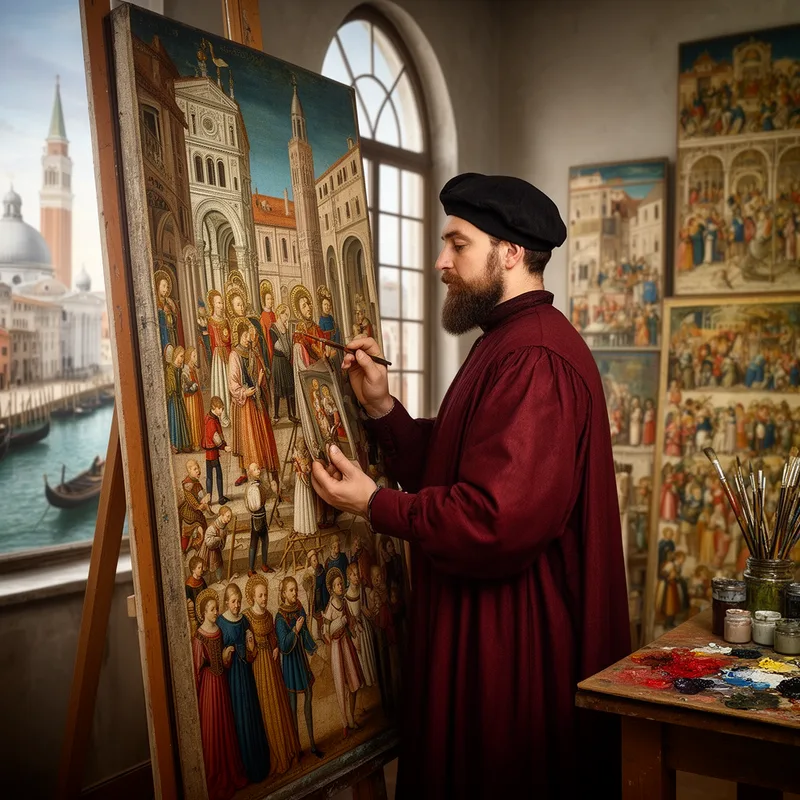
Carpaccio


 1
9.9
- proper noun
- /kɑrˈpɑːtʃoʊ/
- The Venetian painter Vittore Carpaccio pictured Saint Augustine seated at a table in a roomy study, pausing, his pen raised from the paper.
- Carpaccio and Bellini
- Carpaccio, and Paolo Veronese
- Carpaccio's painting
Examples
-
Here, Carpaccio has imagined an Early Christian altar, adorned not by a carved and painted retable but by a freestanding bronze.
Academic text (2005) -
The work was made in the Veneto in the early 1490s and could be found, at the time Carpaccio painted his picture, on an altar in the Venetian church of S. Maria della Carità in Venice.
Academic text (2005) -
Let us return to the Carpaccio painting, moving outward from the statue.
Academic text (2005) -
In the statue of Christ at the center of his picture, Carpaccio captured such an artifact, half relic and half fiction.
Academic text (2005) -
The famous painting 'Saint George and the Dragon' is one of the masterpieces by Carpaccio.
-
Many art historians admire the narrative detail in Carpaccio's works from the Renaissance period.
-
In the gallery, visitors paused to appreciate the vibrant colors used by Carpaccio in his religious scenes.
Surface Forms
Etymology
Carpaccio is the family name of Vittore Carpaccio, a Venetian painter of the Renaissance known for rich, red colours in his scenes. A helpful way to remember him is that in the 1950s a chef named a thin raw beef dish 'carpaccio' because the bright red meat reminded him of those reds, so the name now makes you think of his vivid paintings.