
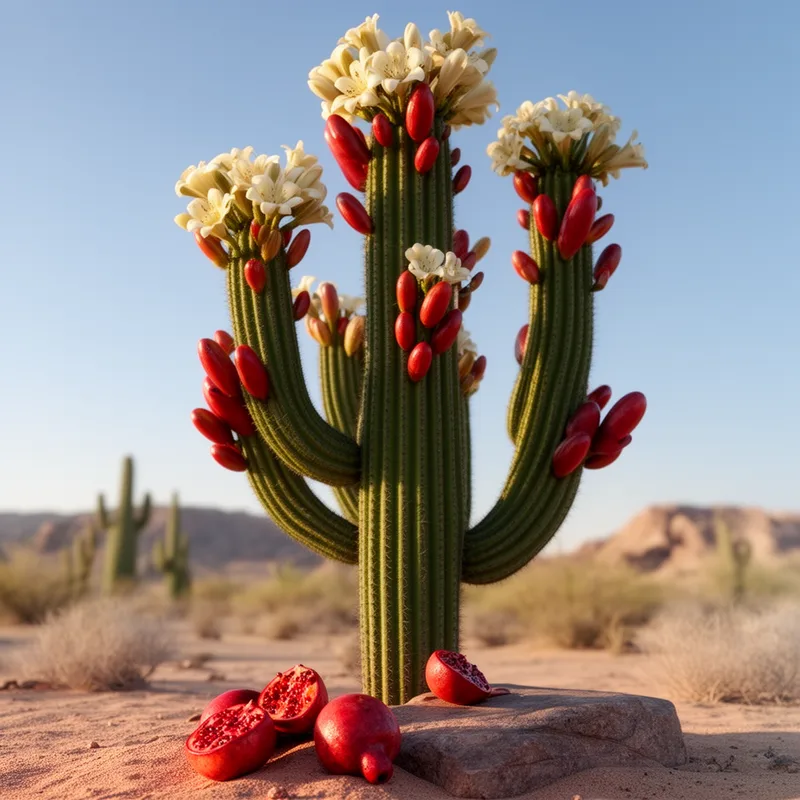
Carnegiea gigantea
- noun
- /kɑrˈnɪɡiə dʒɪˈɡæntiə/
- Specialized
- The Sonoran Desert is famous for its towering Carnegiea gigantea that can live for over 150 years.
Examples
-
The fruit of Carnegiea gigantea is harvested by Native American communities for its sweet, edible pulp.
-
The Carnegiea gigantea can grow up to 40 feet tall.
-
Researchers studied the blooming cycles of Carnegiea gigantea in response to climate change.
-
Have you ever seen a Carnegiea gigantea in person?
-
The Sonoran Desert is famous for its towering Carnegiea gigantea, which can reach heights of up to 40 feet and has a striking appearance.
-
Researchers studied the blooming cycles of Carnegiea gigantea in response to varying seasonal temperatures.
-
The fruit of Carnegiea gigantea is often collected by families in the region, cherished for its sweet and nutritious qualities.
Synonyms
 5
8.7
5
8.7

A very large cactus like a tree that grows in the desert and has white flowers and red fruit
A very large cactus that grows in the desert and has white flowers and red fruit

A group of cactus plants that has only the saguaro in the Sonoran Desert of North America
Surface Forms
Morphology
Carnegiea + gigantea
The name combines the genus 'Carnegiea' (a saguaro cactus) with the Latin epithet 'gigantea' (meaning 'giant' or very large), so a learner who knows both parts can plausibly infer 'a very large saguaro cactus'. However, this is a scientific Latin binomial and relies on taxonomic naming conventions and recognition of the Latin adjective form, so the composition is not a straightforward everyday English pattern for most learners.
Etymology
Carnegiea gigantea is a scientific name: Carnegiea honors Andrew Carnegie, a rich donor, and gigantea is a Latin word meaning 'giant'. So the name literally reads as 'Carnegie's giant', which fits the very tall saguaro cactus.