
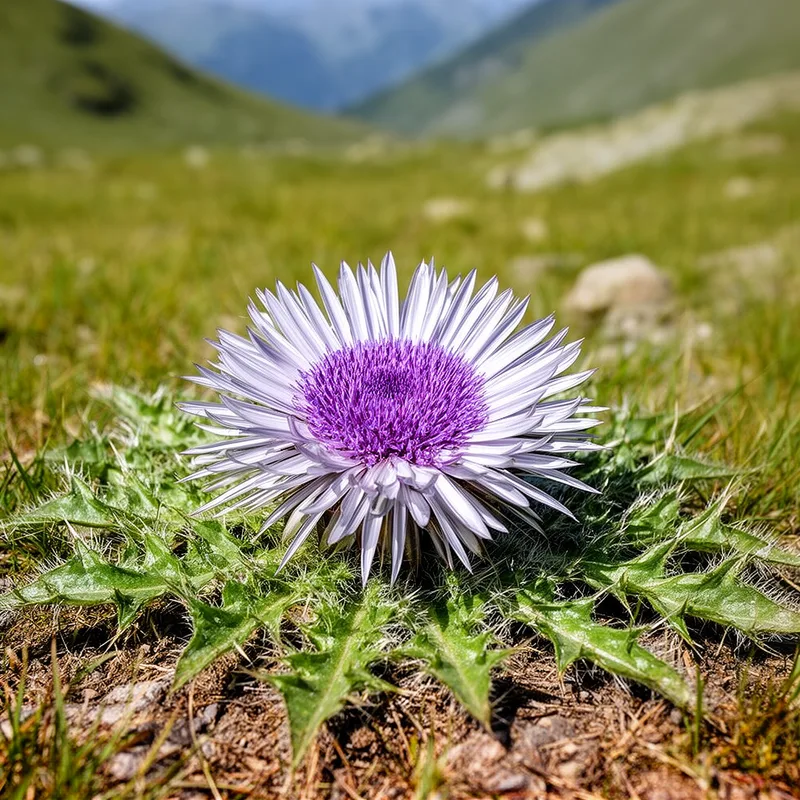
Carlina acaulis
- noun
- Specialized
- The Carlina acaulis is often seen growing close to the ground in sunny alpine meadows.
Examples
-
Botanists admire the striking appearance of the Carlina acaulis when it blooms in late summer.
-
During our hike, we spotted the vibrant Carlina acaulis with its distinctive spiny leaves and large flowers.
-
Some traditional herbal remedies in Europe have used parts of the Carlina acaulis for medicinal purposes.
-
Look at that stunning Carlina acaulis blooming!
-
The Carlina acaulis is native to alpine regions.
-
The Carlina acaulis thrives in harsh alpine environments, showcasing its resilience and beauty.
-
Garden enthusiasts often seek the Carlina acaulis for its unique floral display in rock gardens.
Synonyms

A low mountain plant that lies close to the ground with a large, spiny flower head and hairy leaves
Surface Forms
Morphology
Carlina + acaulis
The name is a Latin binomial: 'Carlina' names the genus (a kind of daisy/thistle) and 'acaulis' is a botanical Latin adjective meaning 'stemless', so the compound literally denotes a 'stemless Carlina'. This is compositionally derivable for someone who knows both constituents (and especially familiar with botanical/Latin formation), but it relies on technical/Latin knowledge not expected of an average B1 learner and is not a normal English phrasal pattern, so it is only partially transparent.
Etymology
Carlina acaulis mixes a historical name and a simple Latin description. One popular story says Carlina comes from the old ruler Charlemagne, and acaulis literally means 'without a stem', so the name helps you remember this daisy-like plant grows flat to the ground with no tall stem.

