
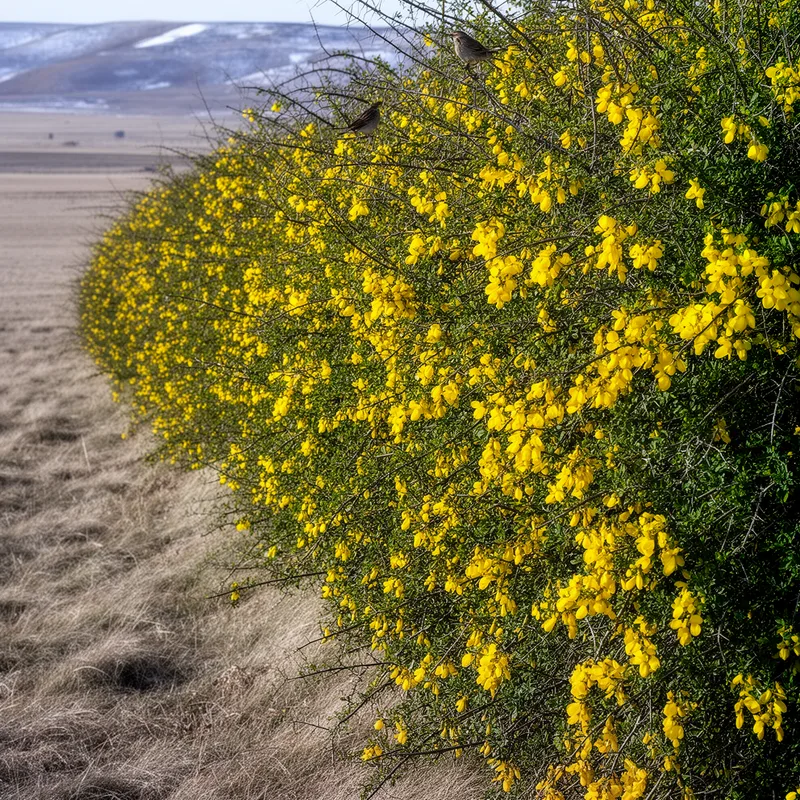
Caragana arborescens
- noun
- Specialized
- Gardeners appreciate Caragana arborescens for its resilience and bright yellow spring flowers.
Examples
-
Caragana arborescens is commonly planted as a windbreak on farms in cold climates.
-
The hedge of Caragana arborescens provides excellent shelter for birds and pollinators.
-
The Caragana arborescens blooms beautifully in spring.
-
Many gardeners choose Caragana arborescens for its hardiness.
-
Caragana arborescens is commonly planted as a windbreak on farms in cold climates.
-
The hedge of Caragana arborescens provides excellent shelter for birds and pollinators.
-
Gardeners appreciate Caragana arborescens for its resilience and bright yellow spring flowers.
Synonyms

A large spiny shrub with groups of yellow flowers often planted to block wind or make a hedge
Surface Forms
Morphology
caragana + arborescens
The binomial combines 'caragana' (a shrub) with the Latin adjective 'arborescens' (literally 'becoming tree-like'), so the components together point to a large, tree-like shrub — a compositional clue to the meaning. However, 'arborescens' is a specialist Latin botanical term and scientific names behave like proper names, so an average B1 learner who does not know Latin-derived botanical vocabulary would not reliably infer the meaning without prior exposure.
Etymology
Caragana arborescens describes how the plant looks: Caragana is the plant group and arborescens means 'tree-like'. Because this spiny shrub can grow into a small tree and makes a dense hedge, the name helps you remember it as a large, tree-like bush used for shelter and windbreaks.

