
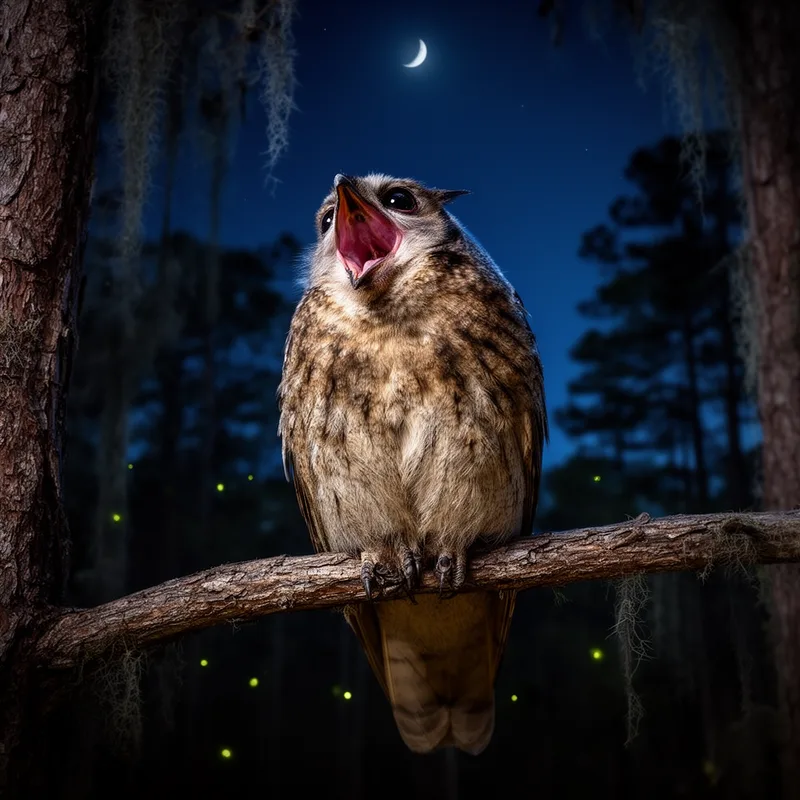
Caprimulgus carolinensis
- noun
- /ˌkæprɪˈmʌlɡəs ˌkɛrəˈlɪnɛnsɪs/
- Specialized
- The Caprimulgus carolinensis is often heard on warm southern nights, calling its distinctive song.
Examples
-
Unlike the smaller whip-poor-will, the Caprimulgus carolinensis has a larger body and a deeper call.
-
The Caprimulgus carolinensis is often heard on warm southern nights, calling its distinctive song as it hunts for insects.
-
Birdwatchers travel to the Southeast to catch a glimpse of the elusive Caprimulgus carolinensis.
-
The Caprimulgus carolinensis is often heard at night.
-
Have you ever seen a Caprimulgus carolinensis in the wild?
-
Birdwatchers travel to the Southeast to catch a glimpse of the elusive Caprimulgus carolinensis at dusk.
-
Unlike the smaller whip-poor-will, the Caprimulgus carolinensis has a larger body and a deeper call that can carry for miles.
Synonyms


 1
9.9
1
9.9
A large bird that is active at night in the southern United States with a loud repeated call
Surface Forms
Morphology
Caprimulgus + carolinensis
This is a scientific binomial in Latin; the parts are taxonomic labels rather than ordinary English words whose meanings compose to give 'a large nocturnal bird of the southern United States.' An average B1 learner, even if shown the constituent labels, would not be able to derive the common-bird meaning from the genus/species names (the species epithet 'carolinensis' may hint at Carolina to those familiar with Latin/taxonomy, but that knowledge exceeds B1). Therefore the expression functions as an arbitrary name and is not transparently interpretable from its parts.
Etymology
Caprimulgus carolinensis gets its name from old words people thought meant 'goat-sucker' because these night birds were often seen near farm animals and people imagined they drank milk at night. That strange picture helps you remember it is a large 'night' bird also called the 'Chuck-will's-widow'.