

Canute the Great
- proper noun
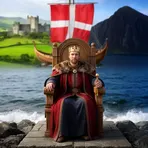
- The legend of Canute the Great rebuking his flattering courtiers at the seashore is often retold in English history.
Examples
-
Many historians regard Canute the Great as one of the most effective rulers of early medieval Europe.
-
Canute the Great unified the crowns of England, Denmark, and Norway under his reign.
-
King Canute the Great was known for his strong leadership.
-
Did Canute the Great really try to stop the tide?
-
Canute the Great unified the crowns of England, Denmark, and Norway under his reign.
-
Many historians regard Canute the Great as one of the most effective rulers of early medieval Europe.
-
King Canute the Great was known for his strong leadership.
Synonyms

 1
9.9

A king of Denmark, Norway and England in the early 1000s

 1
9.9
King who ruled England, Denmark, and Norway in the early 11th century
 1
9.9
King of Denmark, Norway and England in the early 1000s who ruled all England after 1016
Surface Forms
Morphology
This is a transparent name-plus-epithet construction: a learner who knows 'Canute' as a person and 'great' as meaning distinguished or honored will readily infer that 'Canute the Great' refers to the distinguished/honored Canute (i.e. the king). The pattern name + 'the Great' to mark a notable ruler is common cross-linguistically and follows straightforward compositional logic, so no special idiomatic knowledge is required.
Etymology
Canute the Great was a king who ruled England, Denmark, and Norway around the year 1000. One famous story says he sat by the sea and told the tide to stop to show his advisors that a king cannot control nature, and because he united many lands and was a strong ruler people later called him 'the Great'.