
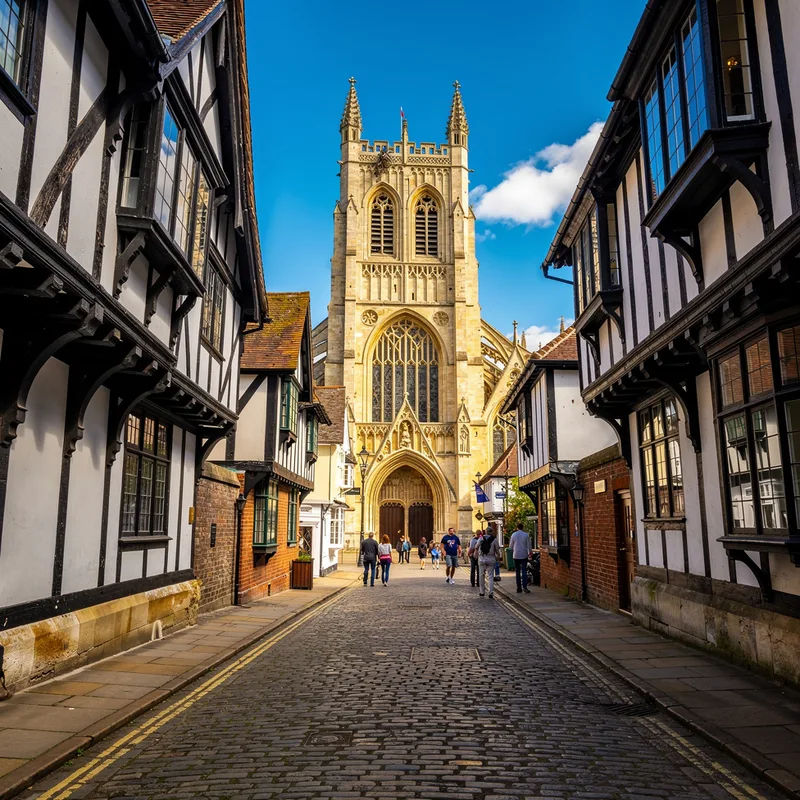
Canterbury
 18
4.1
18
4.1

- proper noun
- /ˈkæntərˌbɛri/
- Now after he graduated, George moved to Canterbury and this is George looking bored in Canterbury because Canterbury is sedate and pious.
- the archbishop of Canterbury
- Anselm of Canterbury
- Canterbury Tales
Loading YouTube…
Watch on YouTubeBut before they're able to do that, the East End of Canterbury Cathedral burns to the ground.
- But before they're able to do that, the East End of Canterbury Cathedral burns to the ground.
- The one city where some continuity of life is Canterbury.
- He appoints this guy loud to be Archbishop of Canterbury.
- I went home, then married George and ended up in a lovely big house in Canterbury.
- So tonight's talk is about this guy Ansel of Canterbury.
- Anselm of Canterbury, who punished a few people.
- This line about long spoons and devils originated from Trousers Canterbury Tales.
Examples
-
The historic city of Canterbury is known for its stunning cathedral.
-
In nearly fifty years at Canterbury, he had seen it all come and go and come again.
Fiction book (1995) -
To make you King, we need the Archbishop of Canterbury to do that.
-
Your Highness, we travel to Canterbury with simple articles of faith.
-
The message from the Archbishop of Canterbury, Primate of the Church of England, came the following morning.
Fiction book (1995) -
Stephen Gray had been a successful silk dyer from Canterbury.
-
Address for correspondence: R. N. Hughes, Department of Psychology, University of Canterbury, Christchurch 1, New Zealand.
Academic text (1990) -
Every summer, thousands of tourists visit Canterbury to explore its rich history.
-
The Archbishop of Canterbury resides in a grand building next to the cathedral.
Compounds

- Literature
2
8.0
A collection of stories written by Geoffrey Chaucer about people traveling to Canterbury

Surface Forms
Etymology
Canterbury comes from Old English parts: Cantware meaning 'people of Kent' and burh meaning 'fort' or 'town'. So Canterbury was originally the 'fort of the Kent people', which helps explain why it became an important historic city and religious center with a famous cathedral.