

Canis lupus arctos
- noun
- /ˈkeɪnɪs ˈluːpəs ˈɑrktoʊs/
- Specialized
- Researchers observed a pack of Canis lupus arctos hunting caribou last winter.
Examples
-
The Canis lupus arctos is well adapted to survive the freezing temperatures of the Arctic tundra.
-
Because of its white coat, Canis lupus arctos blends in seamlessly with the snowy landscape.
-
Because of its white coat, Canis lupus arctos is often difficult to spot against the snow.
-
The Canis lupus arctos is often found in the tundra regions.
-
Many researchers study the Canis lupus arctos for its unique adaptations.
-
Researchers studied a pack of Canis lupus arctos as they migrated across the Arctic region.
-
The Canis lupus arctos is known for its impressive hunting skills in the harsh conditions of the Arctic.
Synonyms


 1
4.4
1
4.4
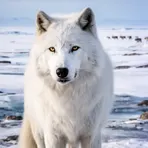
A white wolf that lives in Arctic North America and has a black-tipped tail
 1
4.2
1
4.2
A large wolf that lives in Arctic North America and has white fur
Surface Forms
Morphology
Canis + lupus + arctos
This is a Latin taxonomic (genus–species–subspecies) name whose meaning is compositionally derivable: Canis (genus of dogs/wolves) + lupus (wolf) + arctos (Arctic) yields an Arctic wolf/subspecies of gray wolf. Binomial/trinomial scientific naming is a regular, cross‑linguistic convention, so a learner who knows the constituent parts can infer the MWE's meaning.
Etymology
Canis lupus arctos is a scientific name built from older words: Canis means 'dog', lupus means 'wolf', and arctos means 'north' or 'arctic'. So the name paints a simple picture — a wolf of the far north with a white coat (and often a black-tipped tail), which is why we use it today for this Arctic type of wolf.