
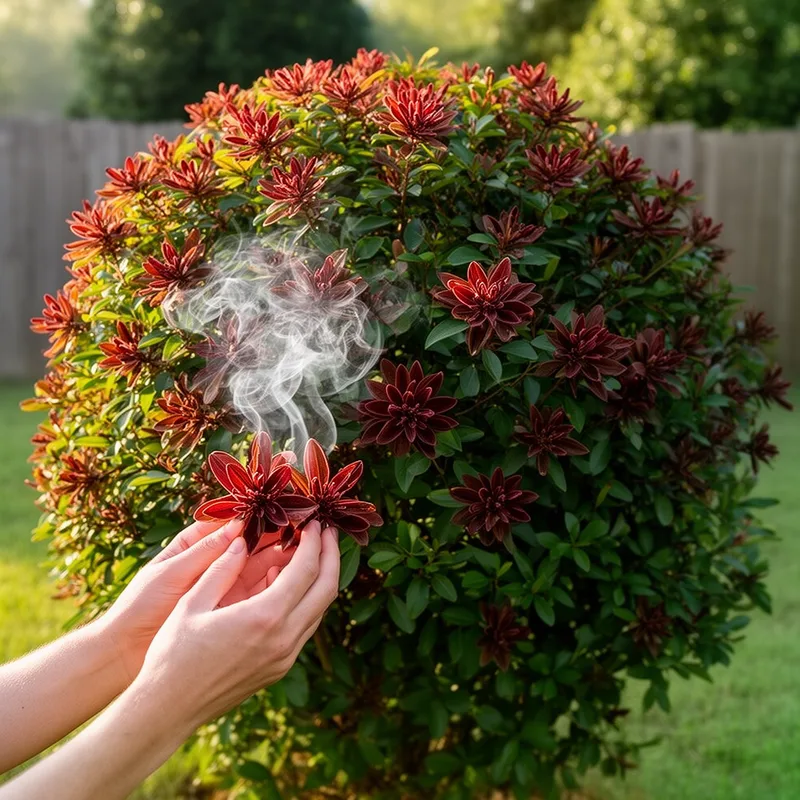
Calycanthus floridus
- noun
- /ˌkælɪˈkænθəs ˈflɔːrɪdəs/
- Specialized
- The Calycanthus floridus in our garden fills the air with its spicy, clove-like fragrance in the spring.
Examples
-
In the southeastern United States, Calycanthus floridus is a popular choice for natural hedges and ornamental gardens.
-
Gardeners often plant Calycanthus floridus for its attractive reddish-brown flowers and fragrant wood.
-
The Calycanthus floridus blooms beautifully in the spring.
-
Many gardeners love Calycanthus floridus for its sweet scent.
-
Gardeners often plant Calycanthus floridus for its attractive reddish-brown flowers and fragrant wood.
-
In the southeastern United States, Calycanthus floridus is a popular choice for natural hedges and ornamental gardens.
-
The Calycanthus floridus in our garden fills the air with its spicy, clove-like fragrance in the spring.
Synonyms

A hardy bush from the southeastern United States with reddish-brown flowers that smell like cloves

A hardy shrub with clove-scented wood and fragrant reddish-brown flowers

A tough bush from the southeast United States with wood that smells like cloves and reddish brown fragrant flowers
Surface Forms
Morphology
Calycanthus + floridus
This is a Latin scientific binomial (a proper name for a species) rather than a compositional English phrase, so its referent is a specific botanical species and not predictable from ordinary English word-combination rules. Even if a learner knew 'Calycanthus' as a genus and inferred a Latin root like 'floridus' relates to flowers, they would not recover the detailed horticultural meaning (hardy shrub, native range, clove-scented wood), so it is not transparently derivable for a B1 learner.
Etymology
Calycanthus floridus is a shrub whose wood and flowers give a strong 'clove-like' scent, so people called it 'Carolina allspice' or 'sweetshrub'. That's why it is known today for its fragrant, reddish-brown flowers and is often planted for its scent.

