
Callot


 1
9.9
- proper noun
- /kæˈloʊ/
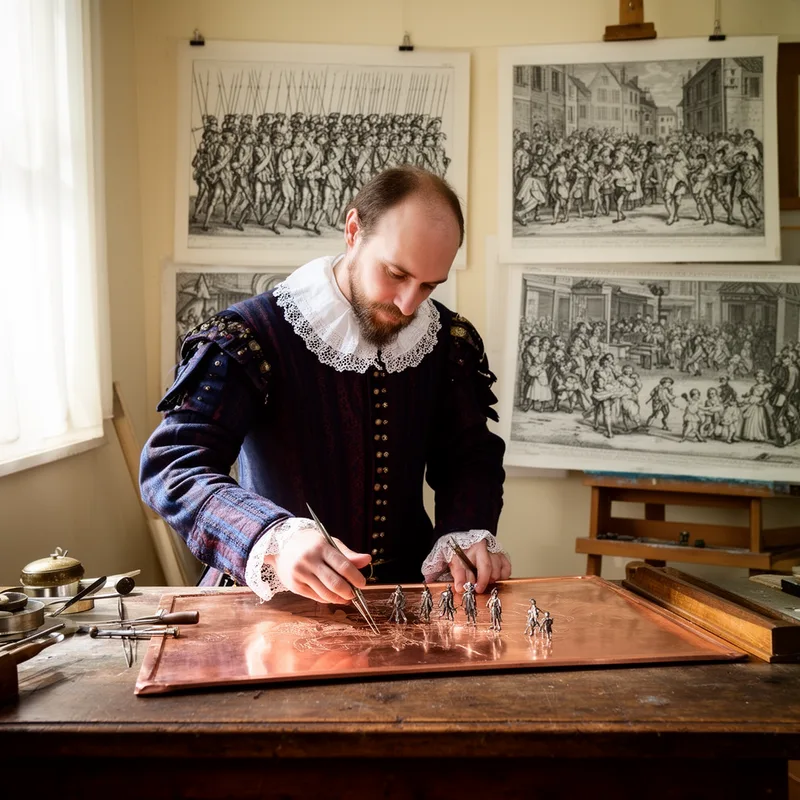
- Jacques Callot is celebrated for his intricate etchings of battles and daily life.
- Callot's prints
- Callot's series
- Callot's Fair
Examples
-
Jacques Callot's Fair at Impruneta, dated 1620, is exemplary of this shift in artistic taste (Fig. 7).
Academic text (2014) -
The foreground areas of the Siege of Breda include several vignettes that Callot later reused in his Miseries of War.
Academic text (2014) -
On his return to Nancy, Callot made a second version of the print, presumably because the original plate remained in Florence.
Academic text (2014) -
Even so, it is Callot as much, if not more than Poussin, who represents the connecting link to the past.
Academic text (2001) -
More recently, it has been proposed that Callot's series promoted contemporary ideas regarding the organization of armies.
Academic text (2014) -
To take one particularly clear instance, Callot's Pillage of an Inn provided Galle with a template for his own treatment of the theme.
Academic text (2014) -
Callot arranged to have three Views of Brussels sold by Brussels print seller Jean Morel, Martin, or Marin.
Academic text (2014) -
Callot's print series is extraordinarily serious in tenor, offering a polemical commentary on the conduct of the military.
Academic text (2014) -
However, it was once again Jacques Callot's prints that provided Galle with the most recent and updated model of this Flemish theme to emulate.
Academic text (2014) -
Many art historians regard Callot as a key figure in the development of printmaking in the 17th century.
Surface Forms
Etymology
Callot is a French family name best known from Jacques Callot, a famous printmaker of the 1600s who made very detailed etchings of soldiers and everyday life. A helpful way to remember Callot is to imagine him 'calling' scenes out with sharp lines on metal, so the name now stands for those detailed prints.