

Callorhinus ursinus
- noun
- Specialized
- Unlike other seals in the region, Callorhinus ursinus has a thick, luxurious fur coat that once attracted fur traders.
Examples
-
The Callorhinus ursinus population has suffered declines due to commercial hunting in the past.
-
The Callorhinus ursinus is often seen along the coast of California.
-
Researchers have studied the migration patterns of the Callorhinus ursinus across the Pacific Ocean.
-
Have you ever spotted a Callorhinus ursinus in the wild?
-
Researchers have studied the migration patterns of the Callorhinus ursinus across the North Pacific.
-
The Callorhinus ursinus population has suffered declines due to commercial hunting in the North Pacific.
-
Unlike other seals in the region, the Callorhinus ursinus has a thick, luxurious fur coat that once attracted traders.
Synonyms
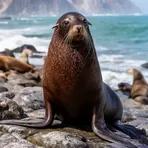
A large sea mammal with thick fur that lives on the Pacific coast from Alaska to California
Surface Forms
Morphology
Callorhinus + ursinus
This is a Latin binomial scientific name (taxonomic label) rather than an ordinary English phrase; its meaning (a specific species of fur seal) is learned conventionally and is not compositionally derivable by a B1 learner from the parts. One constituent ('ursinus') is non‑transparent/missing from the learner dictionary and the genus name is technical, so knowing the surface words would not allow a learner to infer the species meaning.
Etymology
Callorhinus ursinus may come from old Greek and Latin words: callo- and -rhinus meaning a 'beautiful nose', and ursinus meaning 'bear-like'. The image of a seal with a noticeable nose and thick, bear-like fur helps explain why this name refers to the northern fur seal.

