
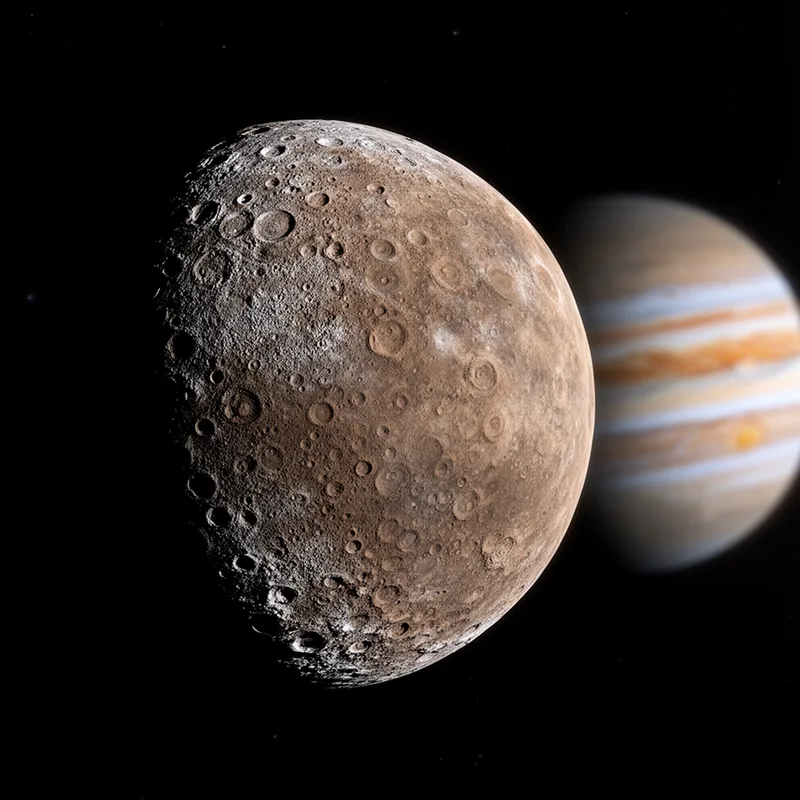
Callisto
 1
7.8

- proper noun
- /kəˈlɪstoʊ/
- Specialized
- Astronomers often study Callisto to understand the history of impacts in our Solar System.
- Callisto and Ganymede
Examples
-
Eclipse lengths vary because these moons don't always pass through the middle of Jupiter's shadow: Ganymede averages 3.25 hours, while Callisto takes about 4 hours.
Academic text (2002) -
It's 7.15 days between transits for more distant Ganymede and 16.69 days between transits for Callisto when transits happen at all.
Academic text (2002) -
Callisto is one of Jupiter's moons.
-
So IO, Europa, Ganymede and Callisto should come in next.
-
In the case of Ganymede and Callisto, several hours can elapse between the time when a satellite first transits and when its shadow appears.
Academic text (2002) -
Callisto entered its most recent eclipse season late last year and will regularly pass through Jupiter's shadow on each orbit until about 2004.
Academic text (2002) -
Io's disk appears grayish on Jupiter's cloudtops, while Europa is very light and often difficult to recognize, especially when it lies in front of a bright band in Jupiter's atmosphere. Ganymede and Callisto appear somewhat darker, so they are usually easy to see.
Academic text (2002) -
In 1609-1610, Galileo had used his new telescope to discover four moons circling Jupiter (later named Io, Europa, Ganymede, and Callisto).
Academic text (2002) -
Jupiter's second largest moon, Callisto, is known for its heavily cratered surface.
-
During a clear night, Callisto can be seen shining brightly alongside Jupiter in the sky.
Surface Forms
Etymology
Callisto comes from the Greek name Kallisto, which comes from kallos meaning 'beauty' or 'most beautiful' and is the same root you see in calligraphy ('beautiful writing'). Astronomers named Jupiter's moon Callisto after that woman from a Greek myth, so the moon's name links back to the old idea of 'beauty' even though the surface is very heavily cratered.