
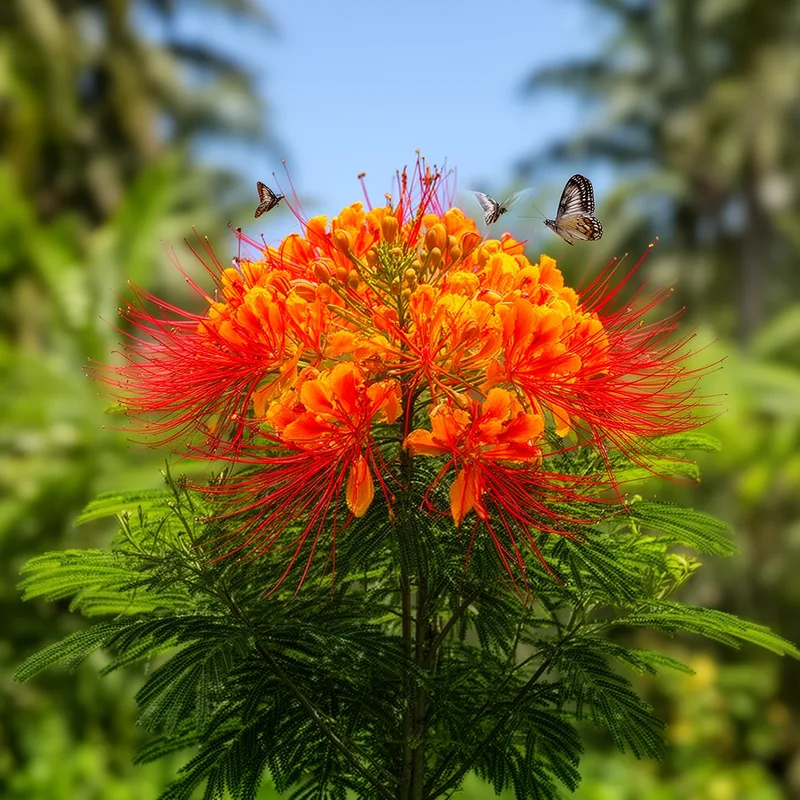
Caesalpinia gilliesii
- noun
- Specialized
- The striking flowers of Caesalpinia gilliesii attract many butterflies and hummingbirds.
Examples
-
The Caesalpinia gilliesii in our garden blooms beautifully every summer.
-
The Caesalpinia gilliesii produces vibrant orange flowers that brighten up the landscape.
-
Botanists often refer to Caesalpinia gilliesii as the bird of paradise bush.
-
The garden featured a stunning Caesalpinia gilliesii in full bloom.
-
Have you seen the Caesalpinia gilliesii at the botanical garden?
-
In the spring, our Caesalpinia gilliesii bursts into color, attracting numerous pollinators.
-
Known for its beauty, the Caesalpinia gilliesii is often planted in tropical gardens.
Synonyms

A tropical tree with bright orange-red flowers and feathery leaves

A tropical tree with bright orange or red flowers
Surface Forms
Morphology
Caesalpinia + gilliesii
The genus name 'Caesalpinia' conveys useful lexical information (a tropical tree/shrub with showy flowers), so part of the compound is transparent. However 'gilliesii' is a species epithet (a proper-name label with no dictionary meaning) and does not add predictable descriptive content, making the full name only partially compositional and not fully derivable by a learner.
Etymology
Caesalpinia gilliesii is a scientific name that honours two people: the genus Caesalpinia is named after Andrea Cesalpino, an early plant scientist, and the species name gilliesii honours John Gillies, who found the shrub in South America. So the name tells us who found or studied this bright orange 'bird of paradise' bush rather than describing its flowers.

