
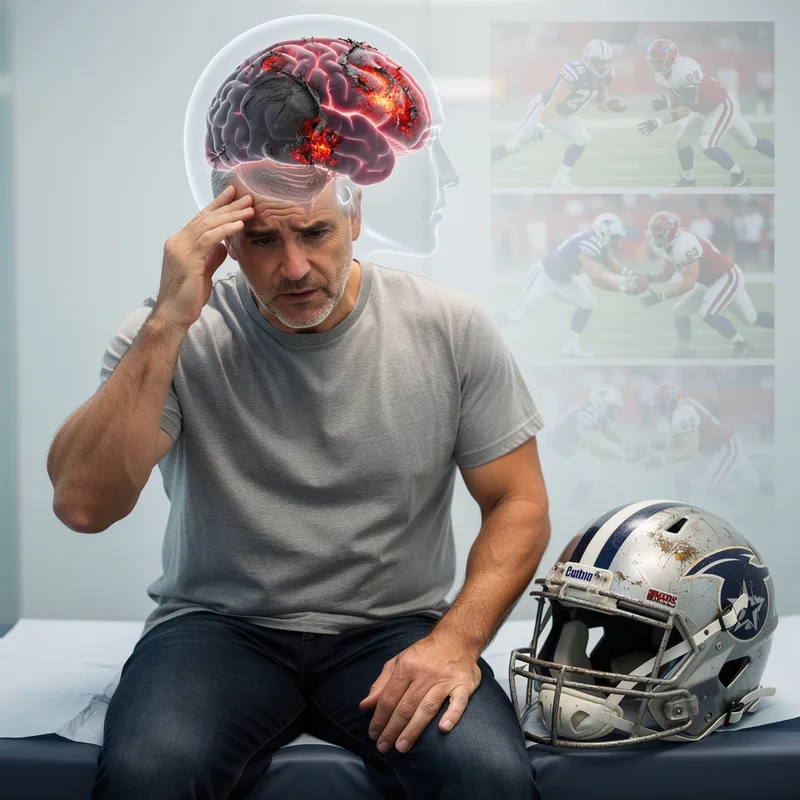
CTE
 5
7.9
5
7.9

- noun
- /siː tiː iː/
- Specialized
- A diagnosis of CTE is typically confirmed only after death through the examination of brain tissue.
- chronic traumatic CTE
- CTE and concussions
- head injury and CTE
Loading YouTube…
Watch on YouTubeI have multiple concussions, CTE or one time I hit a kid so hard.
- I have multiple concussions, CTE or one time I hit a kid so hard.
- I think you know, the football players who have CTE and I mean they've been a lot of suicides.
- So doctor, traumatic brain injuries, TB is or CTE and you as a neuroscientist have you explored?
- Like, you know, you know, AB was basically he got mad about like the CTE questions, which is brain stuff, which is a thing in the NFL.
- And despite controversies around CTE, et cetera, people still watch football.
- Well, they both have CTE, so we know that they're both bruised and Gray matters a little dicey on them.
- I, I want to ask you, man, because you, the CTE thing, which is a big topic now, you said you fell in love with the brain early on.
Examples
-
One of the plaintiffs, former Atlanta Falcons safety Ray Easterling, committed suicide in April at age 62, and an autopsy found he had CTE.
Blog text (24) -
And it is probable, perhaps even likely, that a larger percentage of professional football players have and will die from CTE.
-
I'm living with CTE, which is chronic traumatic encephalitis of the brain.
-
There are 100 former NFL players taking part in research led by Boston University to find a diagnosis for the degenerative brain disease, chronic traumatic encephalopathy, more commonly known as CTE.
Blog text (24) -
JOHN CONYERS: Commissioner Goodell, is there a link between playing professional football and the likelihood of contracting a brain-related injury such as dementia, Alzheimer's, depression or CTE?
-
Athletes who suffer from repeated head injuries are at a high risk of developing CTE, a serious brain disease.
-
Research has shown that CTE often affects those who have played contact sports, leading to severe cognitive issues.
Surface Forms
Etymology
CTE here stands for Chronic 'long-term', Traumatic 'from injury', and Encephalopathy 'brain disease', so it names a brain illness that develops after many head injuries and explains its link to memory and mood problems.