
Bulawayo
 1
7.5

- proper noun
- Some of his carvings were exhibited in the art galleries of Bulawayo and Harare, as well as in Barcelona and Berlin.
- Bulawayo, Zimbabwe
- Bulawayo township
- gallery in Bulawayo
Examples
-
His talent was recognized and his art was exhibited at art galleries in Bulawayo, Harare, and Gaborone (Botswana) over the next few years.
Academic text (2010) -
From 1991 to 1998, I lived as a missionary in Zimbabwe—first in Plumtree, a small town along the border with Botswana, and then in Bulawayo, the second largest city in the country.
Academic text (2010) -
Later, he brought his artwork to Bulawayo.
Academic text (2010) -
In time, he earned sufficient money to rent a room in a Bulawayo township.
Academic text (2010) -
With the help of his younger brother, who owns a pick-up truck, he transports selected logs to Bulawayo.
Academic text (2010) -
A seven-point draft of convictions held in common was adopted for study by MWC member churches in Bulawayo.
Academic text (2006) -
My friend lived in Bulawayo in the heart of Matabeleland, where dissidents loyal to Nkomo still ranged the bush in opposition to Mugabe's government.
Academic text (1992) -
He also found hyrax skins for sale at curio shops within the park and in nearby Bulawayo, Zimbabwe's second-largest city.
Academic text (2009) -
The African Voice was formed in 1947 in Bulawayo with the aim of unifying Africans politically to fight for their economic opportunities and social advancement. Bhebe, B. Burombo, offers the most detailed analysis of Burombo's political activities in both urban and rural areas.
Academic text (2005) -
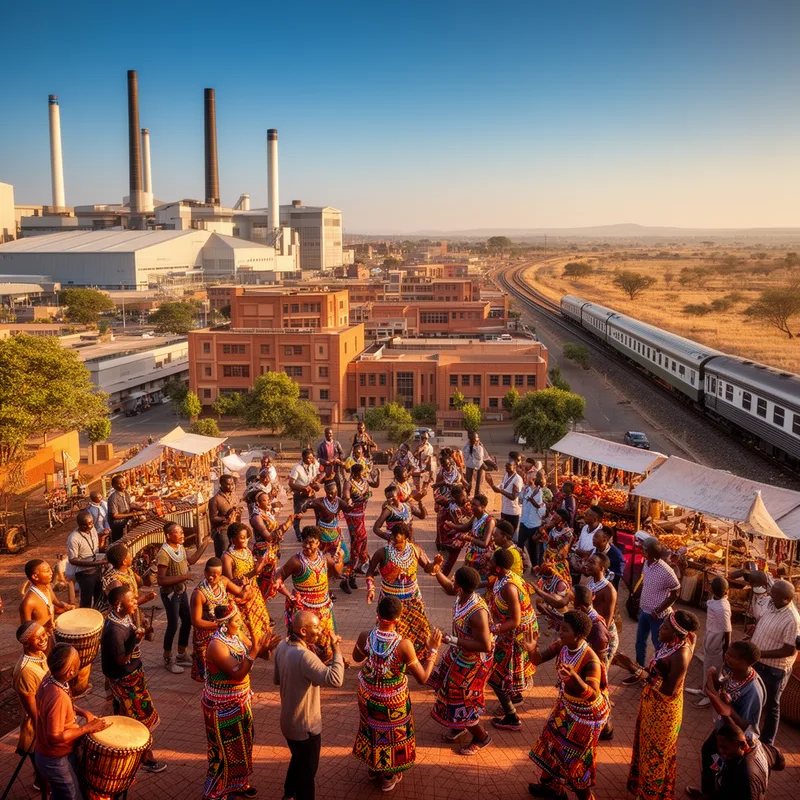
During my travels in Zimbabwe, I visited Bulawayo, a vibrant city known for its rich culture.
Surface Forms
Etymology
The word Bulawayo comes from the Ndebele name uBulawayo, which people often say means 'place of slaughter' or 'place of great trouble' because it began as a royal town involved in battles and the king's power. So the name helps us remember the city's history as an important, strong centre for people and trade.