

Budorcas taxicolor
- noun
- Specialized
- Researchers are studying how the Budorcas taxicolor survives the cold climates of the eastern Himalayas.
Examples
-
The Budorcas taxicolor is well-adapted to mountainous regions with steep terrain and thick forests.
-
The Budorcas taxicolor is native to the eastern Himalayas.
-
Many nature documentaries feature the unique appearance of the Budorcas taxicolor, commonly known as the takin.
-
Did you know that the Budorcas taxicolor can weigh over 300 pounds?
-
The Budorcas taxicolor is an impressive animal known for its size and strength in the rugged terrain of the eastern Himalayas.
-
Conservation efforts are in place to protect the Budorcas taxicolor, which plays an important role in its mountainous ecosystem.
-
Tourists often seek to spot the elusive Budorcas taxicolor while hiking in the beautiful landscapes of the eastern Himalayas.
Synonyms
 3
9.9
3
9.9

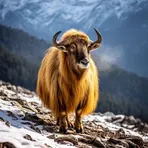
A large goat-like animal with thick shaggy fur and curved horns from the eastern Himalayas

A large goat-like animal that lives on rocky slopes in the eastern Himalayas
Surface Forms
Morphology
Budorcas + taxicolor
This is a Latin binomial (a scientific species name) rather than a compositional English phrase, and the components ('Budorcas' as a genus name and 'taxicolor' unknown in English) do not transparently convey the common meaning 'takin'. Proper names and taxonomic labels are not predictable from their parts for an average B1 learner, so the meaning cannot be derived from the constituents.
Etymology
Budorcas taxicolor comes from old words: Budorcas means 'ox' and taxicolor means 'gazelle'. That picture of a heavy ox and a goat-like gazelle helps explain the name for the 'takin', a large goat-antelope from the eastern Himalayas.