

Bruchus pisorum
- noun
- Specialized
- The larvae of Bruchus pisorum develop inside the pea seeds, making detection difficult.
Examples
-
The infestation of Bruchus pisorum caused significant damage to the farmer’s pea crop.
-
Scientists are studying ways to control Bruchus pisorum without using chemical pesticides.
-
The Bruchus pisorum is a common pest in pea crops.
-
Farmers often struggle with Bruchus pisorum infestations.
-
Farmers often struggle with Bruchus pisorum infestations that threaten their pea crops.
-
The larvae of Bruchus pisorum feed on the seeds of the pea plant, causing extensive damage.
-
Scientists are researching Bruchus pisorum to find eco-friendly solutions for pest control.
Synonyms

A small beetle whose young live in and eat pea seeds
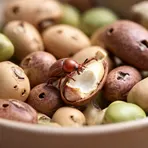
A small insect that eats the seeds of plants like beans or peas

A small beetle that lays eggs in seeds of plants like beans and whose young eat the seeds
Surface Forms
Morphology
Bruchus + pisorum
This is a Latin scientific name (binomial) rather than an English compositional phrase; its parts are taxonomic/Latin forms (Bruchus, pisorum) and not everyday English words. The second element 'pisorum' is not a dictionary word and requires knowledge of Latin/genitive morphology (linking it to peas), so an average B1 learner who knows the listed constituents would not be able to derive the species' meaning.
Etymology
Bruchus pisorum is the scientific name for a small beetle called the pea weevil. Its young live and eat inside pea seeds, so imagine a tiny bug hidden in a pea to remember that it means 'a beetle that lives in and eats pea seeds'.

