
British West Indies
- proper noun
- Literature
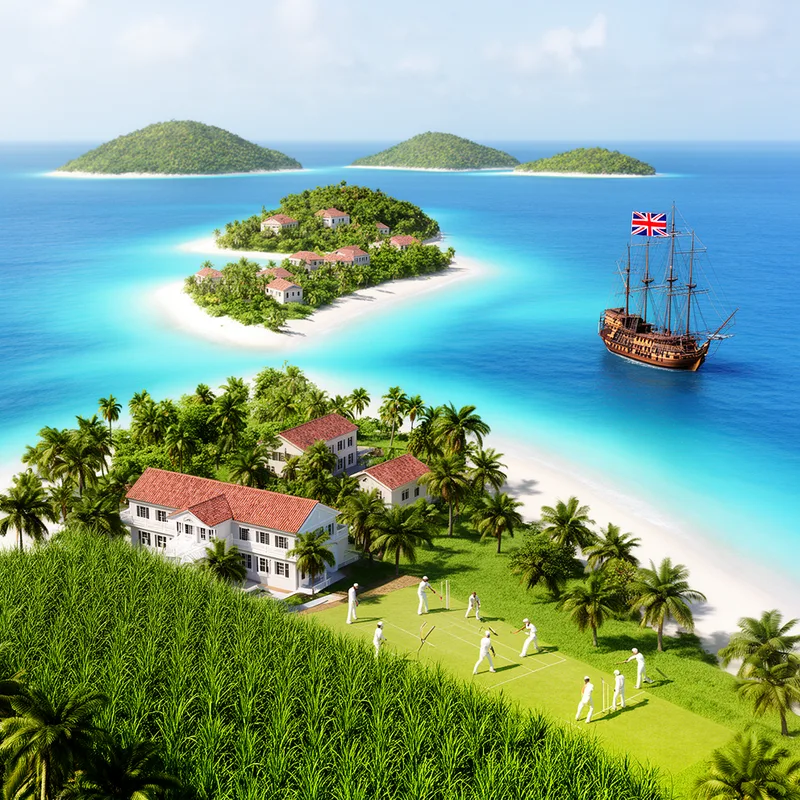
- The Caicos Islands lie scattered north of Haiti in the British West Indies, hidden like lost pearls from a broken string, lost but not forgotten.
Examples
-
The British West Indies include popular destinations like Jamaica and Barbados.
-
The United States could trade with the British West Indies.
Academic text (1993) -
Yet their tale begins at the turn of the century in the British West Indies and is as much about cricket as about baseball.
Academic text (1994) -
Evidence suggests that students from the British West Indies, Canada, and Mexico were studying in the U.S. as early as the 1780s.
Academic text (1992) -
This ensured that the demographic experience of slaves in the British West Indies must be located toward the harsh extreme of the scale of modern world population history, especially before the late eighteenth century when external pressure for amelioration was strong.
Academic text (1994) -
Many tourists flock to the beautiful beaches of the British West Indies every year.
-
Historically, the colonies of the British West Indies played a significant role in trade.
Surface Forms
Morphology
The phrase is compositionally built from 'British' (relating to Britain) + the toponym 'West Indies', so a learner who knows the parts can infer it refers to the West Indies as associated with Britain (i.e., British possessions/heritage). However, 'West Indies' is a conventional historical place-name referring specifically to Caribbean islands, which is lexicalized and may not be fully predictable from the literal words alone, so some background knowledge is needed.
Etymology
British West Indies comes from old people in Europe who called the Caribbean the West Indies because Columbus thought he had reached 'India'. Adding British showed which islands were ruled by Britain, so the name came to mean the Caribbean islands that were British colonies.

