
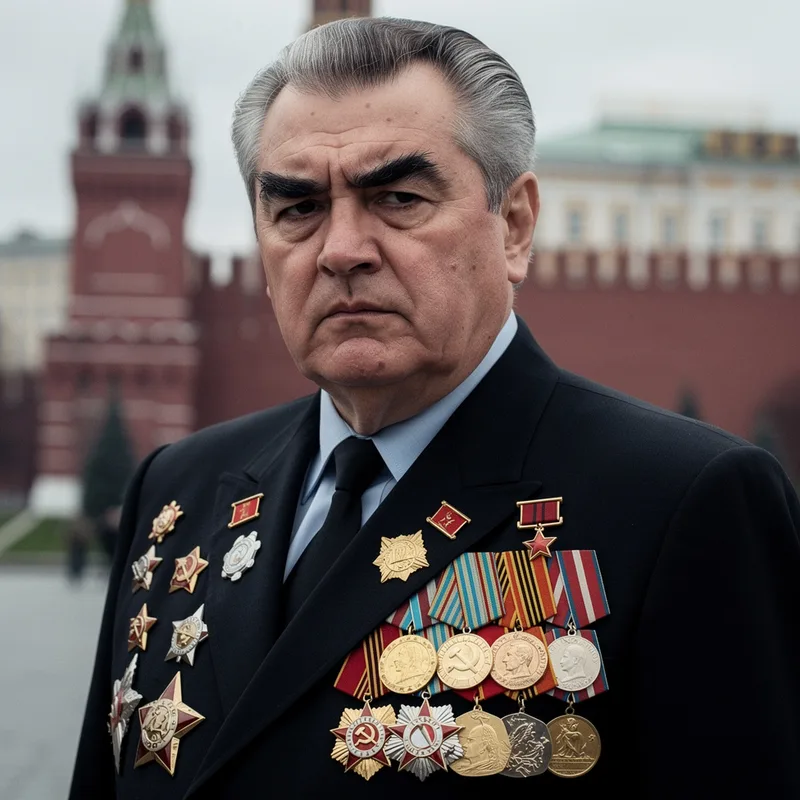
Brezhnev
 16
8.8

- proper noun
- /ˈbrɛʒnɛf/
- Whatever the time period, both men agreed that Brezhnev was passionate and insistent in his presentation.
- Leonid Brezhnev
- Brezhnev Doctrine
- Brezhnev era
Loading YouTube…
Watch on YouTubeBut the end of Soviet history has to do with Brezhnev.
- But the end of Soviet history has to do with Brezhnev.
- And this is a Soviet Union which you know from the reading, from the class, this is the Soviet Union of Brezhnev.
Examples
-
At the first Nixon-Brezhnev summit in May 1972.
Academic text (1990) -
Now, this is where Brezhnev and I had our summit.
-
"Of the six people waiting, five of them look like Brezhnev."
Fiction book (1990) -
The Saudi rejection of the Brezhnev proposal, along with that of other Gulf states, was not insignificant.
Academic text (1990) -
Poland, in contrast, held elections in 1989, when the applicability of the Brezhnev Doctrine was still an open question.
Academic text (1991) -
French and German leaders competed in courting Brezhnev and extolling his virtues.
Academic text (1992) -
During the first Reagan term, the Soviet leadership changed from Leonid Brezhnev to Yuri Andropov to Konstantin Chernenko.
Academic text (1990) -
Clarifying Soviet intentions, Soviet leader Leonid Brezhnev announced in 1968 what would be called the Brezhnev Doctrine, whereby the ideological deviations of any one socialist state had security ramifications for other socialist states.
Academic text (2018) -
During the Cold War, Leonid Brezhnev played a pivotal role in shaping Soviet foreign policy.
-
Leonid Brezhnev, the General Secretary of the Communist Party, governed the Soviet Union for nearly two decades.
Synonyms
 3
8.6
Leader of the Soviet Union from 1964 to 1982
A Soviet political leader who led the country from 1964 to 1982
Surface Forms
Etymology
Brezhnev is a Russian family name. The ending -ev is a common Russian surname part meaning 'belonging to' or 'son of', so the name originally showed a family link and today identifies the Soviet leader Leonid Brezhnev.