
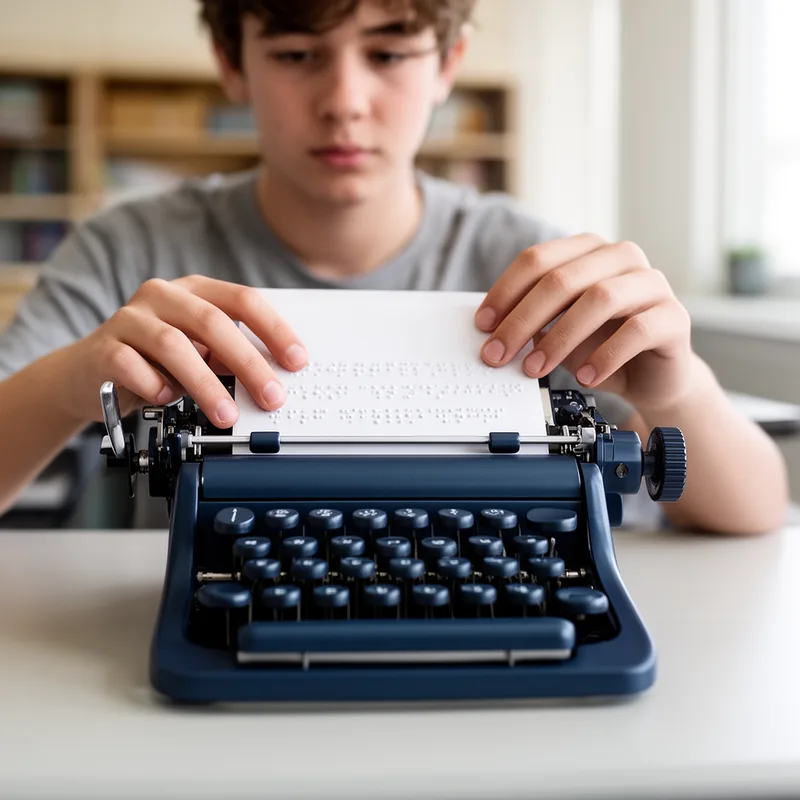
Braillewriter
- noun
- /ˈbreɪlˌraɪtər/
- Specialized
- For example, a sighted student says to a student who is visually impaired, "Your braillewriter is under your desk."
- Perkins Braillewriter
- using a braillewriter
- braillewriter at home
Examples
-
A braillewriter allows individuals to produce written text in Braille for those who are blind.
-
Using a braillewriter, students can create documents that are accessible to visually impaired readers.
-
The braillewriter was used to write the 26 English braille letters.
Academic text (2009) -
Braillewriters, braille books, braille notetakers, and other special equipment emphasize differences.
Academic text (2004) -
Craig (1996) found that using a braillewriter or a slate and stylus to make dots was not an activity that was frequently provided to children who are visually impaired.
Academic text (2009) -
Twenty-six English braille letters were placed on 26 small cards using a Perkins Braillewriter and braillable sheets (which were used for durability).
Academic text (2007) -
The most popular tool for writing braille was a Perkins Braillewriter (n = 77); some students used an electronic brailler (n = 28) or a slate and stylus (n = 11), and 14 students used other tools.
Academic text (2006) -
Each student in the class had a braillewriter to help them learn how to write in Braille.
Synonyms

A machine that makes braille text for people who cannot see
How Automatic
- Specialized

- Specialized
Surface Forms
Morphology
Etymology
Braillewriter comes from Braille, named for Louis Braille, a blind French teacher who made a 'dot' system for reading, and writer, meaning something that 'writes'. So a Braillewriter is like a small typewriter that makes raised 'dots' you can feel, which is why it produces Braille text.

