
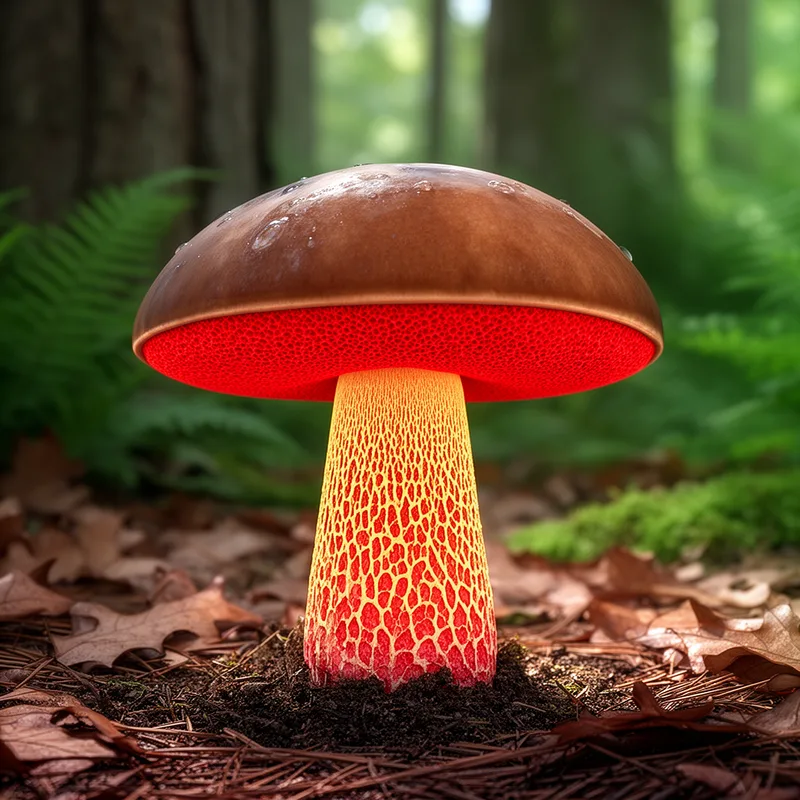
Boletus pulcherrimus
- noun
- Specialized
- Foragers should be cautious of the Boletus pulcherrimus, as it is a beautiful but poisonous mushroom.
Examples
-
The thick, reticulate stalk is a key identifying feature of Boletus pulcherrimus.
-
I found a Boletus pulcherrimus while hiking in the forest.
-
In mycology books, Boletus pulcherrimus is often photographed for its striking coloration.
-
The Boletus pulcherrimus is known for its striking appearance.
-
Foragers should be cautious of the Boletus pulcherrimus, as it is a beautiful but poisonous mushroom.
-
The thick, reticulate stalk is a key identifying feature of Boletus pulcherrimus.
-
In mycology books, Boletus pulcherrimus is often photographed for its striking coloration.
Surface Forms
Morphology
Boletus + pulcherrimus
The compound is a Latin binomial: 'Boletus' clearly signals a genus of mushrooms so a learner who knows that word can infer it names a kind of mushroom, and 'pulcherrimus' is a Latin superlative meaning 'most beautiful', so part of the sense (a particularly notable/beautiful Boletus) is derivable. However, species epithets and scientific names are language-specific conventions and do not convey specific properties like toxicity or pore colour to a B1 learner, and many learners will not know or recognize the Latin epithet, so the meaning is only partly predictable.
Etymology
Boletus pulcherrimus comes from Latin. The first word Boletus names the bolete mushroom group and the second word pulcherrimus means 'most beautiful', so the name literally calls it a very beautiful bolete — a striking image to remember even though the mushroom is poisonous.

