

Beta vulgaris rubra
- noun
- /ˈbeɪtə ˈvʌlɡərɪs ˈruːbrə/
- Specialized
- Beta vulgaris rubra is commonly used in salads and soups due to its sweet flavor.
Examples
-
I bought some Beta vulgaris rubra at the farmer's market.
-
Research has shown that Beta vulgaris rubra is rich in vitamins and minerals beneficial to health.
-
Farmers cultivate Beta vulgaris rubra for both fresh market sales and processing into pickles.
-
Have you tried cooking with Beta vulgaris rubra?
-
Many people enjoy adding Beta vulgaris rubra to their salads for a colorful and nutritious boost.
-
In the summer, I often purchase Beta vulgaris rubra from local farms to use in my cooking.
-
The vibrant color and sweet taste of Beta vulgaris rubra make it a popular choice for juice preparations.
Synonyms

 80
1.0
80
1.0

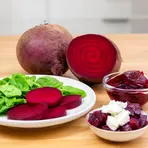
A round red or purple root vegetable that you cook and eat
 3
2.1
3
2.1
A round red root vegetable with dark red inside eaten cooked or raw

A plant with a large root that people grow and eat
Surface Forms
Morphology
This is a Latin scientific name (binomial) rather than an English compositional phrase; an average B1 learner who 'knows' the listed constituents would not reliably map them to 'red beet' because the elements are technical epithets and one constituent is even missing from dictionaries. Only learners with specific knowledge of Latin/biological naming (e.g., that rubra/rubrum = red and vulgaris = common) could infer the meaning, so it is not transparently derivable for typical learners.
Etymology
Beta vulgaris rubra comes from Latin words: Beta means a kind of beet, vulgaris means 'common', and rubra means 'red'. So the name is a simple picture of the red, common beet we eat today.