
Bertillon system
- noun
- /bərˈtɪlən ˈsɪstəm/
- Archaic
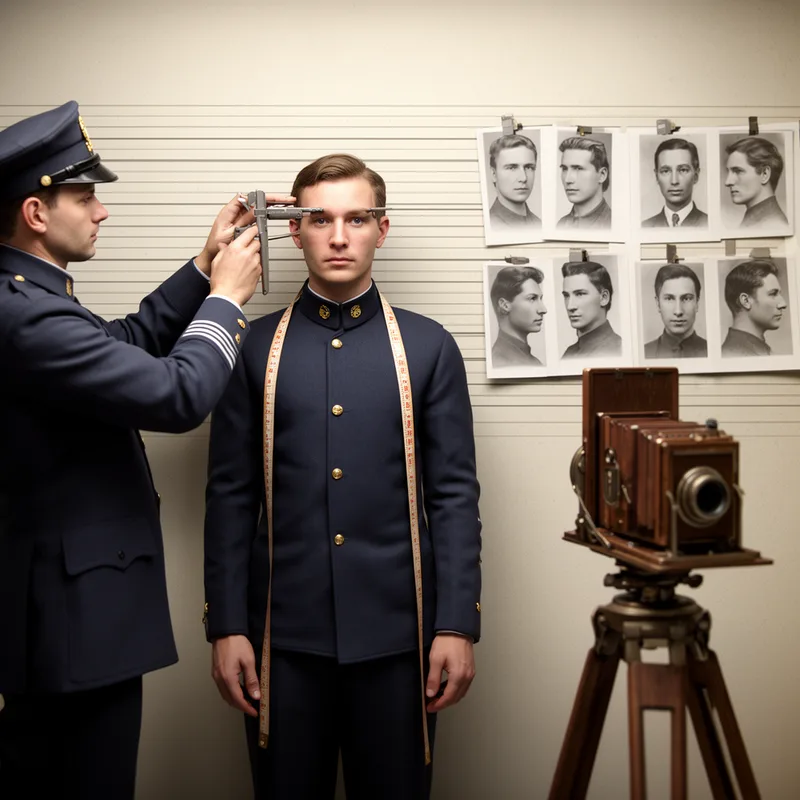
- The Bertillon system, invented in 1882 by Alphonse Bertillon (1853-1914), chief of criminal identification for the Paris police.
- the use of the Bertillon system
Examples
-
One measure he introduced was the use of the Bertillon system of criminal identification on Chinese immigrants at various ports of entry.
Academic text (1992) -
The use of the Bertillon system remained a source of indignation on the part of the Chinese until its use was discontinued in 1906.
Academic text (1992) -
Liang, in his Ji Huagong jinyue, described the use of the Bertillon system in the following manner:
Academic text (1992) -
The Bertillon system was a revolutionary method for identifying criminals based on specific physical measurements.
-
Police departments in the early 20th century adopted the Bertillon system to enhance their identification processes.
-
Alphonse Bertillon developed the Bertillon system to catalog individuals based on unique physical characteristics and photographs.
How Accurate
- Specialized


 1
4.1
1
4.1

- Specialized
7
3.0
- Archaic
Surface Forms
Morphology
Bertillon + system
The phrase follows an eponymous pattern (proper name + system), so a learner who knows 'system' can infer it is a system associated with or developed by someone called Bertillon. However, the specific meaning (detailed anthropometric identification techniques) is not derivable from the name alone, so the full sense is not predictable without prior exposure.
Etymology
Bertillon system is named after police officer Alphonse Bertillon, who in the late 1800s measured people's bodies, took photos and wrote notes about scars and marks to make identity files. That's why the term means 'a system to identify people'.