
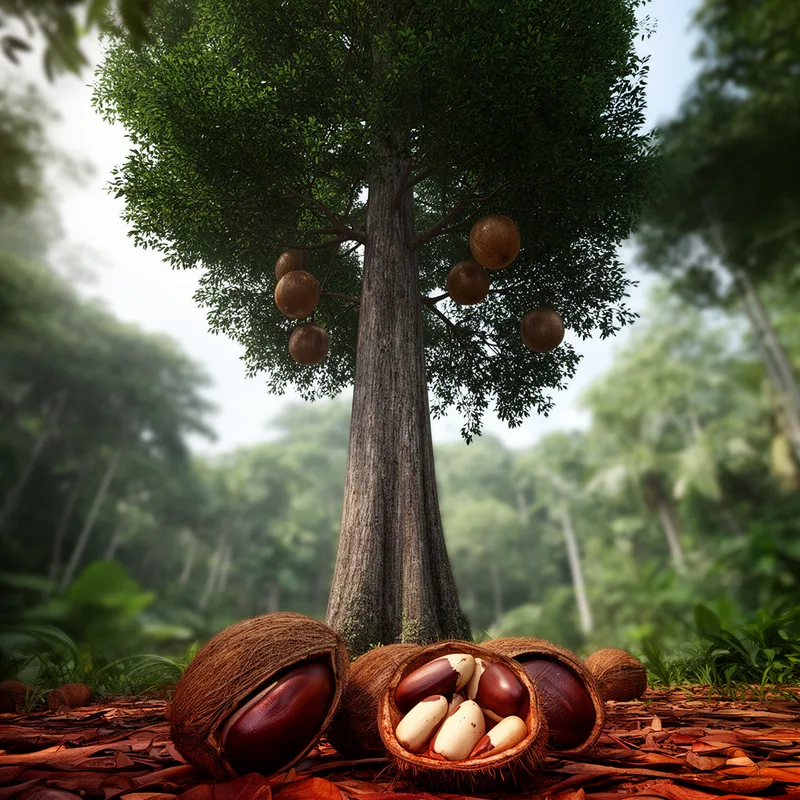
Bertholletia excelsa
- noun
- Specialized
- The Bertholletia excelsa grows in the Amazon rainforest and can reach heights of 50 meters.
Examples
-
The nuts harvested from Bertholletia excelsa are widely exported around the world.
-
The Bertholletia excelsa tree can grow up to 50 meters tall.
-
Researchers are studying the ecological importance of Bertholletia excelsa in South America.
-
Have you ever seen a Bertholletia excelsa in the wild?
-
The large fruits of the Bertholletia excelsa are rich in nutrients and often harvested for their edible nuts.
-
In South America, the Bertholletia excelsa tree is crucial to the local ecosystem, providing food for various wildlife.
-
Many communities rely on the sustainable harvest of Bertholletia excelsa nuts as a key source of income.
Synonyms

A tall Amazon rainforest tree that makes large seeds you can eat

A very tall tree in the Amazon that produces Brazil nuts
Surface Forms
Morphology
Bertholletia + excelsa
This is a scientific Latin binomial rather than a compositional English phrase: 'Bertholletia' is a genus label with no descriptive meaning for most learners and 'excelsa' is an untranslated Latin epithet (not a common English word). A B1 learner who knows the listed constituents would not reliably infer 'Brazil nut tree' from them, because understanding the species name requires specialist/Latin knowledge rather than normal word-combination reasoning.
Etymology
The name Bertholletia excelsa is named for French scientist Claude-Louis Berthollet, and the part excelsa is Latin for 'tall' or 'lofty'. So the name gives a clear picture of a very tall Amazon tree named for a person, which helps you remember it is the big South American tree that makes Brazil nuts.

