
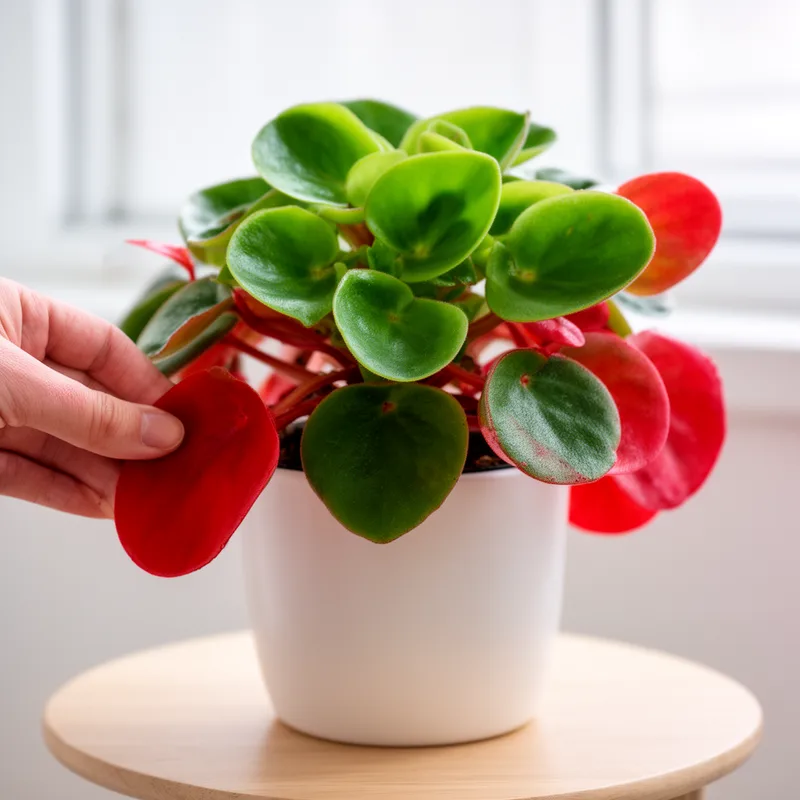
Begonia feastii
- noun
- Specialized
- In the botanical garden, the Begonia feastii stood out with its striking reddish leaf undersides.
Examples
-
Many people choose Begonia feastii for its attractive, fleshy leaves and vibrant colors.
-
The Begonia feastii in the conservatory thrived in the humid environment.
-
Gardeners prize Begonia feastii for its uniquely colored foliage.
-
She bought a Begonia feastii to add to her collection of houseplants.
-
I recently bought a Begonia feastii for my garden.
-
The Begonia feastii has beautiful round leaves.
-
To enhance her indoor garden, she carefully selected a Begonia feastii for its ornamental beauty.
Synonyms
A plant often grown indoors with round thick leaves that are red underneath

A houseplant with round, thick leaves that are red underneath and used for decoration

A houseplant with round, thick leaves that are red underneath and kidney-shaped
Surface Forms
Morphology
Begonia + feastii
This is a binomial species name: 'Begonia' clearly signals the plant genus so a learner who knows 'Begonia' will understand it denotes a type of begonia, but 'feastii' is a Latinized specific epithet (likely an eponym) that carries no independent, descriptive meaning. Because the head provides the general category but the species epithet does not convey the specific trait information in the definition, the expression is only partially compositional and thus semi-transparent.
Etymology
Begonia feastii combines the group name Begonia and the second part feastii, which probably comes from the surname 'Feast' of the person who first found or described the plant. Its round, colourful leaves are like a little 'feast' for the eyes, so the name helps you remember it is a showy plant grown for its looks.

