
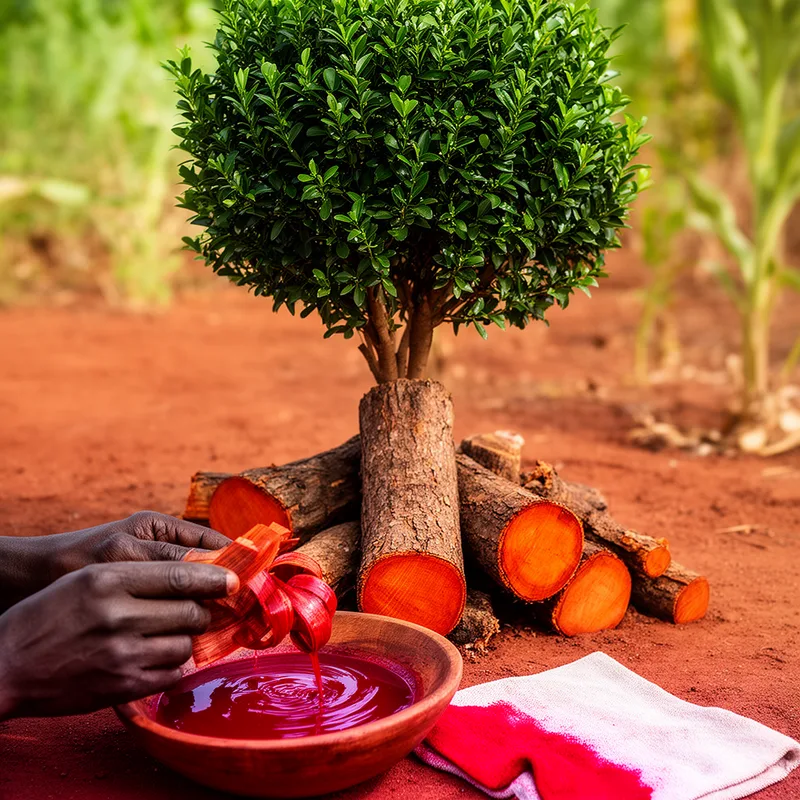
Baphia nitida
- noun
- Specialized
- Artisans in West Africa have used Baphia nitida for centuries to color fabrics.
Examples
-
The wood of Baphia nitida is prized for its vivid red dye.
-
Farmers in West Africa cultivate Baphia nitida for its valuable dye.
-
Botanists study Baphia nitida for its unique chemical properties.
-
The Baphia nitida tree thrives in the tropical climate.
-
Artisans in West Africa have long used Baphia nitida to create vibrant red dyes for textiles.
-
The wood of Baphia nitida is specifically sought after for its ability to produce deep red dye.
-
Farmers in West Africa cultivate Baphia nitida because its dye is highly valued in local markets.
Synonyms
A small African tree with hard red wood that people use to make red dye
A small African bush with hard red wood that people use to make dye
Surface Forms
Morphology
Baphia + nitida
This is a Latin binomial (scientific name) rather than a compositional English phrase; knowing the genus name 'Baphia' and an undefined element 'nitida' does not let a B1 learner derive the plant's properties (a West African shrub used for dye). Scientific species names function as arbitrary labels and require botanical or Latin knowledge, so the overall meaning is not predictable from the parts.
Etymology
The plant name Baphia nitida may come from an old word for 'to dip' because its wood was used to make a bright red dye. Here Baphia points to 'dyeing' and nitida to a 'shiny' look, so the name links the tree to its use and appearance.

