
Balzacian


 1
9.9
- adjective
- /bælˈzɑː.zi.ən/
- Literature
- Critics praised the Balzacian depth of his storytelling, noting its realism and complex character development.
Examples
-
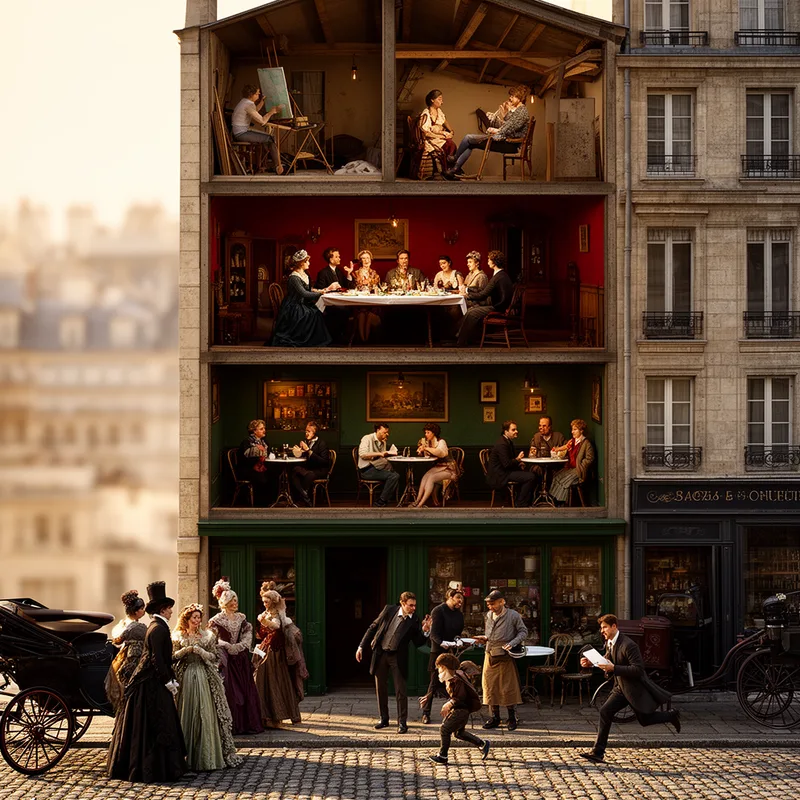
The film offers a Balzacian portrait of 19th-century Paris, with attention to social detail and personal ambition.
-
The novel presents a Balzacian view of Parisian society.
-
Her novels create a Balzacian panorama of society, capturing the ambitions and struggles of a wide range of characters.
-
Many critics describe his writing style as Balzacian.
-
The novel presented a Balzacian view of 19th-century French society, rich in detail and character.
-
Her writing style is Balzacian, filled with intricate plots and vivid portrayals of everyday life.
-
In his critiques, he often highlights Balzacian themes of ambition and social struggle among the characters.
Surface Forms
Morphology
Balzacian = Balzac (transparent) = Balzac + ian
Formed by the productive adjectival suffix '-ian' attached to the proper name 'Balzac', yielding 'relating to Balzac' in a directly derivable way.
Etymology
Balzacian comes from the name Balzac, the French writer Honoré de Balzac, and means 'in the style of Balzac'. A helpful way to remember it is to think of words like Shakespearean or Victorian that are made from names, and Balzacian describes stories that give a wide, realistic picture of people and society.