
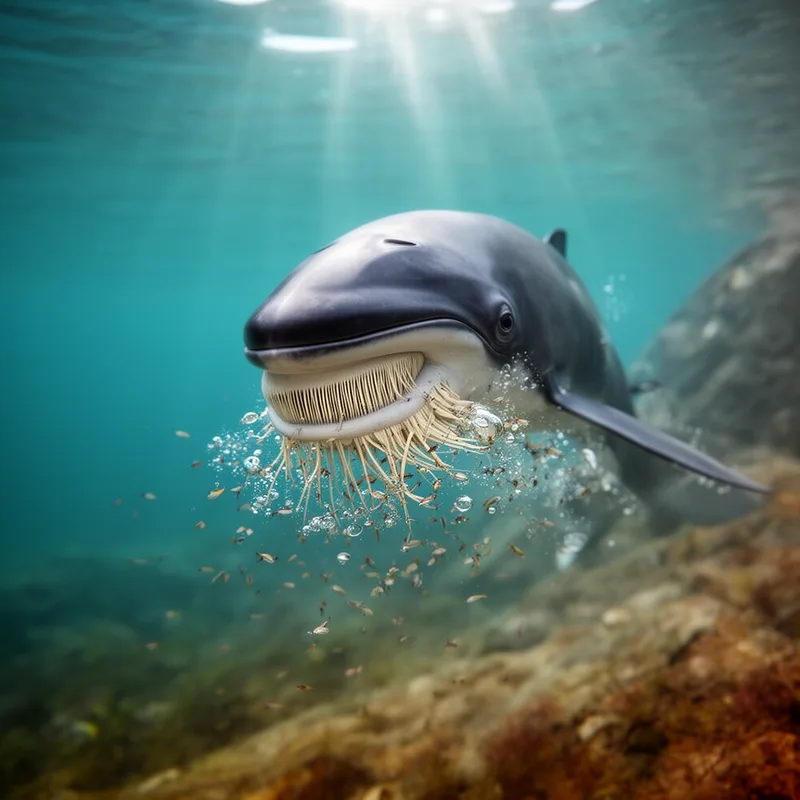
Balaenoptera acutorostrata
- noun
- /ˌbæl.eɪ.nəˈpɛt.rə əˌkjuː.təˈrɒs.trə.tə/
- Specialized
- The Balaenoptera acutorostrata is commonly known as the minke whale among marine biologists.
Examples
-
Scientists recently studied the migration patterns of Balaenoptera acutorostrata in the North Atlantic.
-
Threats to Balaenoptera acutorostrata populations include climate change and commercial fishing activities.
-
The Balaenoptera acutorostrata is known for its slender body.
-
Many researchers study the Balaenoptera acutorostrata in the North Atlantic.
-
Marine biologists have observed the feeding habits of Balaenoptera acutorostrata along the coastlines of both the Atlantic and Pacific Oceans.
-
The Balaenoptera acutorostrata, or minke whale, can often be seen in coastal waters during the summer months.
-
Conservationists are working to protect Balaenoptera acutorostrata from threats like pollution and climate change.
Synonyms
 1
6.2
1
6.2

A small whale with a dark, smooth body and a small fin on its back
A small whale like a minke whale that lives near coasts
A small whale that lives near coasts, like the minke whale
Surface Forms
Morphology
Balaenoptera + acutorostrata
This is a Latin scientific name: 'Balaenoptera' signals a genus of large baleen whales, so a learner who recognises that element could infer it refers to a kind of whale. However 'acutorostrata' is a Latinized species epithet not transparent to a B1 learner, so the precise identity 'minke whale' and any specific meaning cannot be derived from ordinary English word knowledge.
Etymology
Balaenoptera acutorostrata comes from old Latin words: Balaenoptera joins words for 'whale' and 'wing', showing its long side fins, and acutorostrata means 'sharp snout', its pointed nose. So the name gives a simple picture of the minke whale, a small baleen whale with wing-like fins and a pointed face.