
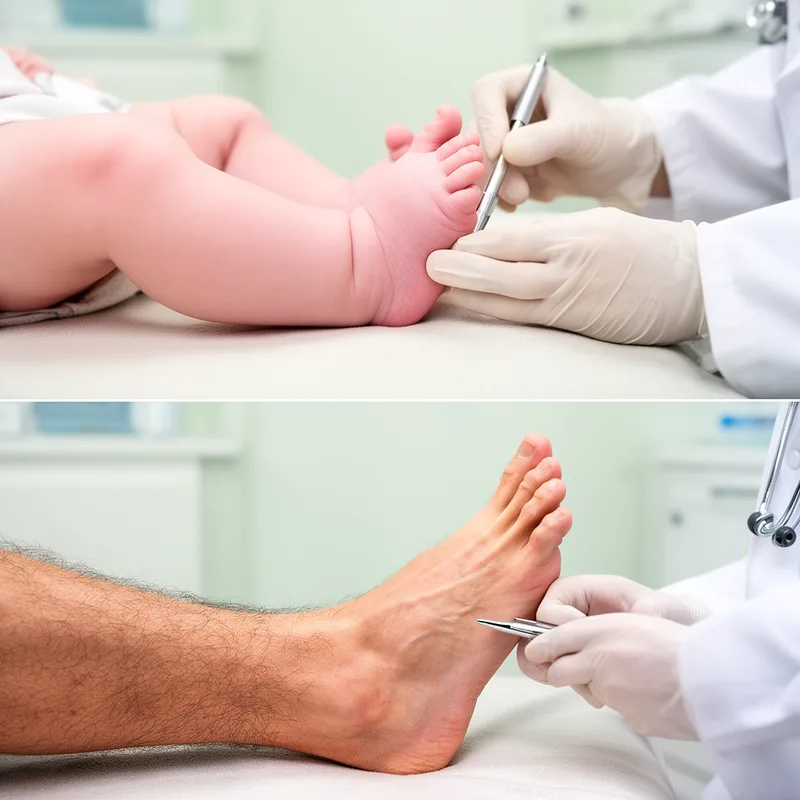
Babinski sign
- noun
- /bəˈbɪnˌski saɪn/
- Specialized
- A positive Babinski sign in adults can indicate a problem with the central nervous system.
Examples
-
Doctors usually observe the Babinski sign in infants as a normal reflex.
-
The neurologist checked for the Babinski sign during the patient's examination.
-
The doctor checked for the Babinski sign during the examination.
-
In infants, the Babinski sign is a normal reflex.
-
A positive Babinski sign in adults can indicate a problem with the central nervous system.
-
Doctors usually observe the Babinski sign in infants as a normal reflex.
-
The neurologist checked for the Babinski sign during the patient's examination.
Synonyms


 1
6.8
1
6.8
Toes move up when the sole is touched, normal in babies but may show nerve damage in adults

An upward movement of the toes when someone strokes the bottom of the foot
Surface Forms
Morphology
This is an eponymic medical term: 'Babinski' is a proper name and 'sign' only indicates a medical symptom, so a B1 learner who knows those words would not be able to derive the specific reflex meaning (upward big toe on sole stimulation). The specialised clinical sense requires domain knowledge rather than compositional interpretation, making the expression non-predictable from its parts.
Etymology
Babinski sign comes from the doctor Joseph Babinski, who noticed that when the sole of the foot is rubbed the big toe moves up. Doctors call this visible movement a 'sign' because it can show 'nerve damage' in older children and adults, so the phrase means that medical finding.