
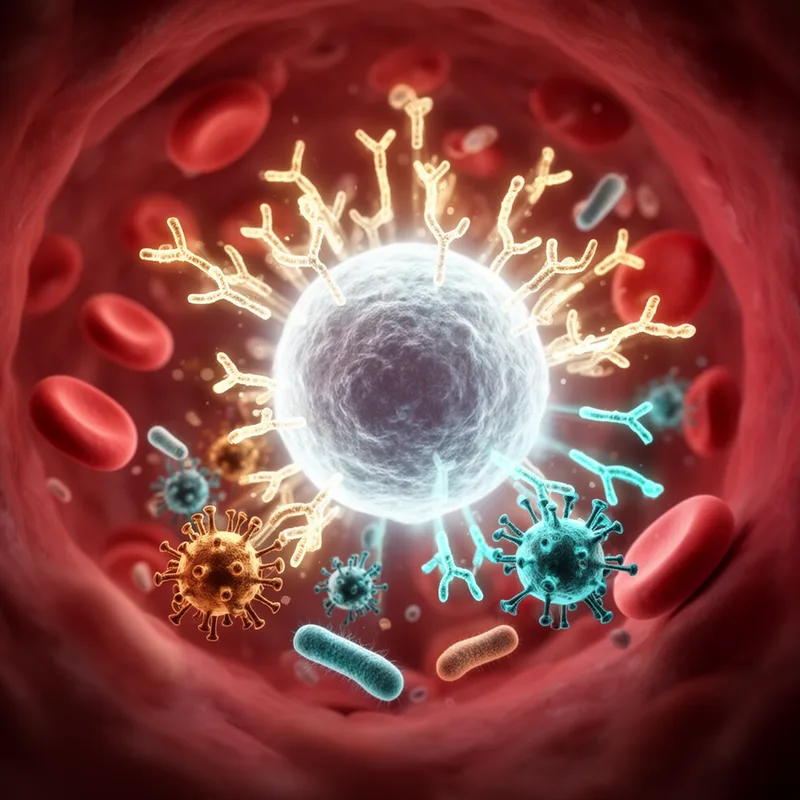
B cell
 5
4.3
5
4.3

- noun
- /biː sɛl/
- Specialized
- B cells help protect the body by producing antibodies that fight infections.
- B cells lymphoma
- B cell activation
- B cells produce antibodies
Loading YouTube…
Watch on YouTubeThis family of lymphoid cells include the natural killer cell that we've met before, the B cell that we've also met before.
- This family of lymphoid cells include the natural killer cell that we've met before, the B cell that we've also met before.
- There was an increase in the naive B cells and the B cells are basically those naive B cells are not defined yet.
Examples
-
We used simple whole-blood staining to characterize the leukocyte and B-cell subsets directly from the circulation.
Blog text (30) -
Rituximab, the chimeric monoclonal antibody, is directed against B cell surface membrane protein CD20.
Academic text (2006) -
In addition, little is known about the negative regulation of B cells in type 2 immunity.
Academic text (2016) -
Now, when the infection is over, we don't need all these B cells and T cells anymore.
-
Memory B cells turn into plasma cells, which produce wave after wave of the specific antibodies that latch on to HIV to prevent it from infecting cells.
-
Immunophenotyping confirmed that the lymphoid nodules were B cell in nature and that they were Bcl-2 and IgD-positive.
Academic text (2006) -
Histopathologic examination of the tonsil revealed the presence of high-grade non-Hodgkin's lymphoma of the B cell type.
Academic text (2006) -
In addition, specialized follicular helper T (Tfh) cells trigger the maturation of B cells to plasma cells.
Academic text (2016) -
After the infection, many B cells remain in the body to ensure long-lasting immunity.
-
Doctors study B cells to understand how they contribute to autoimmune diseases.
Synonyms


 1
5.7
1
5.7
A white blood cell from bone marrow that makes antibodies to fight infection
Surface Forms
Morphology
The noun 'cell' makes it clear this is a type of cell, so learners who know the constituents can infer it denotes a cell subtype; however, the letter 'B' is an arbitrary label (and not the everyday meaning like the blood group) and does not reveal the specialized function (antibody production) or developmental origin. The term therefore gives partial compositional information but requires domain knowledge to derive the full meaning, so it is not fully transparent to a B1 learner.
Etymology
B cell got its name from a small pouch in birds called the 'bursa', where scientists first found this kind of immune cell. The 'B' in B refers to that pouch, and these cells make antibodies, like tiny soldiers, so the name helps you remember they protect the body.