

Atlantic Coast
 5
1.8
5
1.8

- noun
- /əˈtlæntɪk koʊst/
- Many cities along the Atlantic Coast, such as Miami and New York, are popular travel destinations.
- U.S. Atlantic Coast
- Atlantic Coast Conference
- Atlantic Coast minorities
Loading YouTube…
Watch on YouTubeSo it's on the Atlantic Coast and it has huge waves.
- So it's on the Atlantic Coast and it has huge waves.
- The next clashes took place on the Atlantic Coast.
Examples
-
The Atlantic Coast is known for its diverse marine life and stunning landscapes.
-
So it's on the Atlantic Coast and it has huge waves.
-
But we're on the Atlantic Coast, which is one of the most amazing waters for seafood.
-
For the past 60 years, the Atlantic Coast Conference has exhibited leadership in academics and athletics.
Blog text (12) -
Southerly trade winds made it easy for ancient ships to sail down the Atlantic Coast of Africa.
-
One group worked up in Okatal, one group worked in Bluefields on the Atlantic Coast, which is a very different population than the Pacific Coast.
-
Five large buyers of eels along the U.S. Atlantic Coast airfreight nearly all the eels.
Academic text (1990) -
By 1860, railroads connected the Atlantic Coast to the Great Lakes (Hatcher 1944).
Academic text (1994) -
Tourists flock to the Atlantic Coast each summer to enjoy the beautiful beaches.
Synonyms
 506
1.0
506
1.0
The land beside the sea or ocean
 441
1.0
441
1.0
Land at the edge of a sea or lake
 145
2.4
145
2.4
The eastern coast of the United States from Boston to Washington DC
 60
1.4
60
1.4
The line where the land meets the sea
 42
4.8
42
4.8
The part of a country along the coast with beaches and towns
 14
1.0
14
1.0
Land at the edge of the sea with sand or rocks
 3
1.0
3
1.0
Land beside the sea or ocean
 3
2.3
3
2.3
The eastern coast of the United States along the Atlantic Ocean between Boston and Washington, DC
 1
3.0
1
3.0
The area right next to the ocean where it meets the shore
 1
1.1
1
1.1
Land next to the sea or ocean

 1
3.4
1
3.4
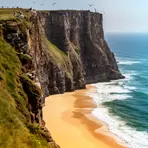
Land near the sea with beaches and often cliffs

Land along the sea, often with beaches
Surface Forms
Morphology
The meaning is transparently compositional: 'Atlantic' specifies which ocean and 'coast' denotes land beside the sea, so an English learner who knows both words can readily infer 'Atlantic Coast' as the land bordering the Atlantic. This is a common, cross-linguistic locative noun + modifier pattern and therefore straightforward for a B1 learner.
Etymology
Atlantic Coast joins Atlantic, the ocean's name, and Coast, which means land next to the sea, to make a simple picture: land beside the Atlantic Ocean. That's why the phrase means 'the region of land bordering the Atlantic', for example the eastern side of North America.