
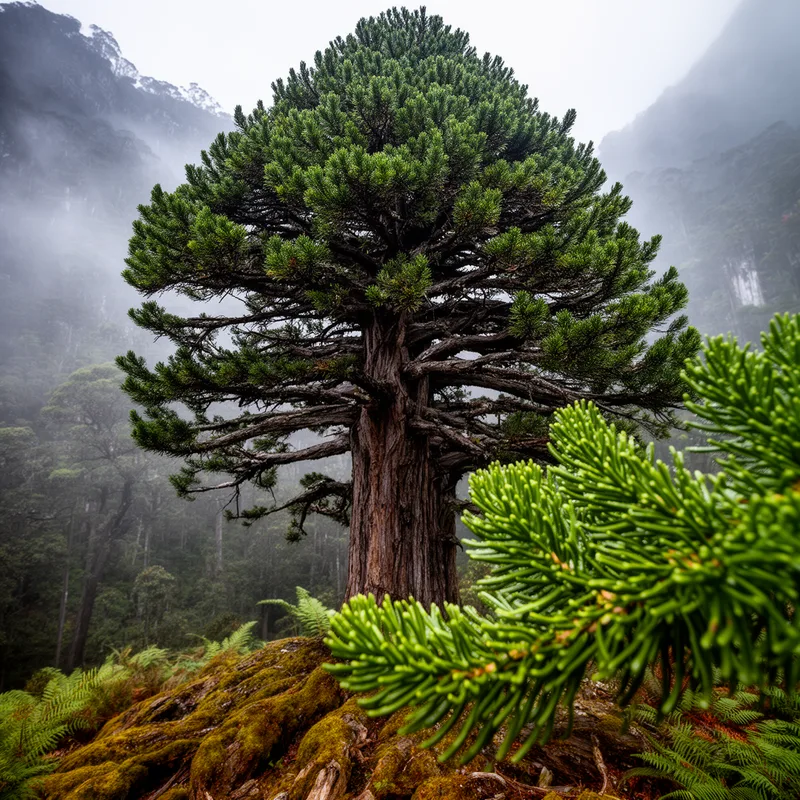
Athrotaxis selaginoides
- noun
- Specialized
- The unique leaves of Athrotaxis selaginoides help distinguish it from other conifers.
Examples
-
Conservation efforts have increased to protect the endangered Athrotaxis selaginoides from logging.
-
The Athrotaxis selaginoides thrives in Tasmania's mountainous regions.
-
Athrotaxis selaginoides can be found in the cool, moist forests of Tasmania.
-
Have you ever seen an Athrotaxis selaginoides in its natural habitat?
-
The Athrotaxis selaginoides is well adapted to the high-altitude environments of Tasmania.
-
In Tasmania, the sharp-pointed leaves of Athrotaxis selaginoides are an important feature for identification.
-
Many hikers enjoy observing Athrotaxis selaginoides while exploring the local forests of Tasmania.
Synonyms
An evergreen mountain tree from Tasmania with sharp leaves that curve inward
Surface Forms
Morphology
Athrotaxis + selaginoides
This is a scientific binomial: knowing 'Athrotaxis' lets a learner infer it refers to a kind of conifer (so the general idea 'a tree/species' is predictable). However, the species epithet 'selaginoides' is a technical Latin element (not transparent to a B1 learner) and the precise descriptive sense (slow‑growing, sharp inward‑curving leaves, etc.) cannot be derived from the constituents, so the meaning is only partially predictable.
Etymology
Athrotaxis selaginoides may come from Greek and Latin parts: Athrotaxis meaning 'crowded rows' and selaginoides meaning 'like a small moss'. Its sharp leaves that curve inwards sit tightly packed and look a bit moss-like on this slow-growing mountain evergreen, so the name fits the tree's appearance today.

