
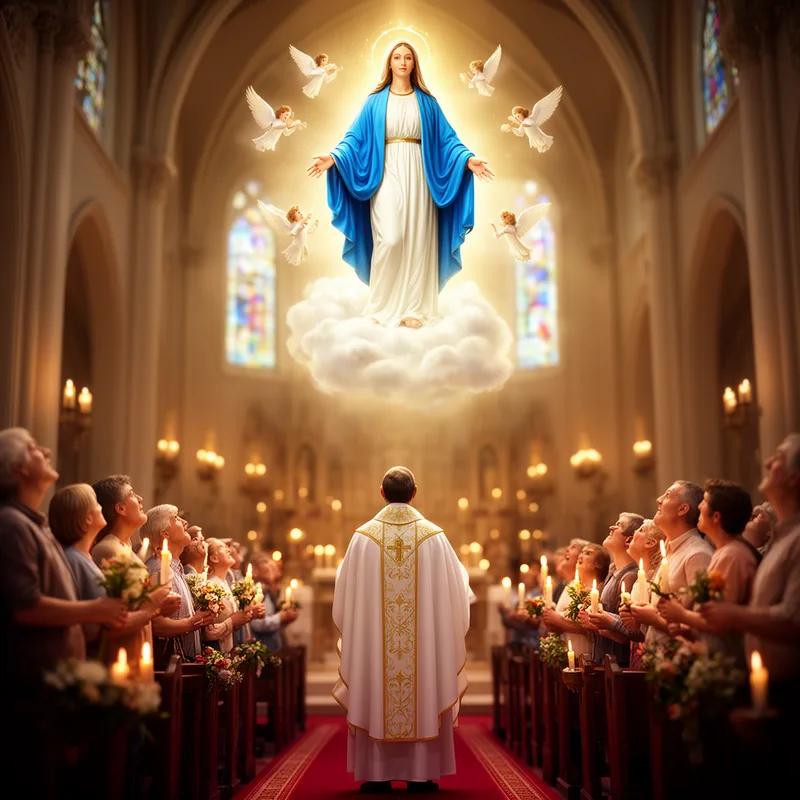
Assumption of Mary
- noun
- /əˈsʌmpʃən əv ˈmɛri/
- The broader teaching activity of bishops may have been moved to the background after the definition of the Assumption of Mary in 1950, when bishops were asked their views on that dogma in little more than a ceremonial way.
- the Assumption of Mary in 1950
Examples
-
During the Assumption of Mary, the faithful commemorate her ascension into heaven.
-
An organic development is illustrated by Pius XII's proclamation of the doctrine of the Assumption of Mary.
Blog text (3) -
When Pius XII defined the Assumption of Mary in 1950, the context-less autonomous Mariology was still in quiet possession of the terrain.
Academic text (2005) -
The Feast of the Assumption of Mary is celebrated every year on August 15.
-
In many countries, the Assumption of Mary is observed with special church services.
Synonyms

 1
9.9
1
9.9

A Christian belief that the Virgin Mary was taken up to heaven at the end of her life

A Catholic holiday when people remember the Virgin Mary going to heaven
Surface Forms
Morphology
Assumption + of + Mary
The phrase is partly compositional: a learner who knows 'assumption' and 'Mary' can infer it refers to Mary being 'assumed' or taken up, and many languages have an equivalent religious term. However, the specific theological sense (taken up into heaven at the end of her life) and its status as a named feast are specialized/religious knowledge and may not be predictable for an average B1 learner, so it is not fully transparent.
Etymology
Assumption of Mary comes from the plain image of the Virgin Mary being gently lifted up into heaven at the end of her life, often shown with angels carrying her. So the phrase now names the church 'belief' and the yearly 'feast' that remembers her being 'taken up into heaven'.