
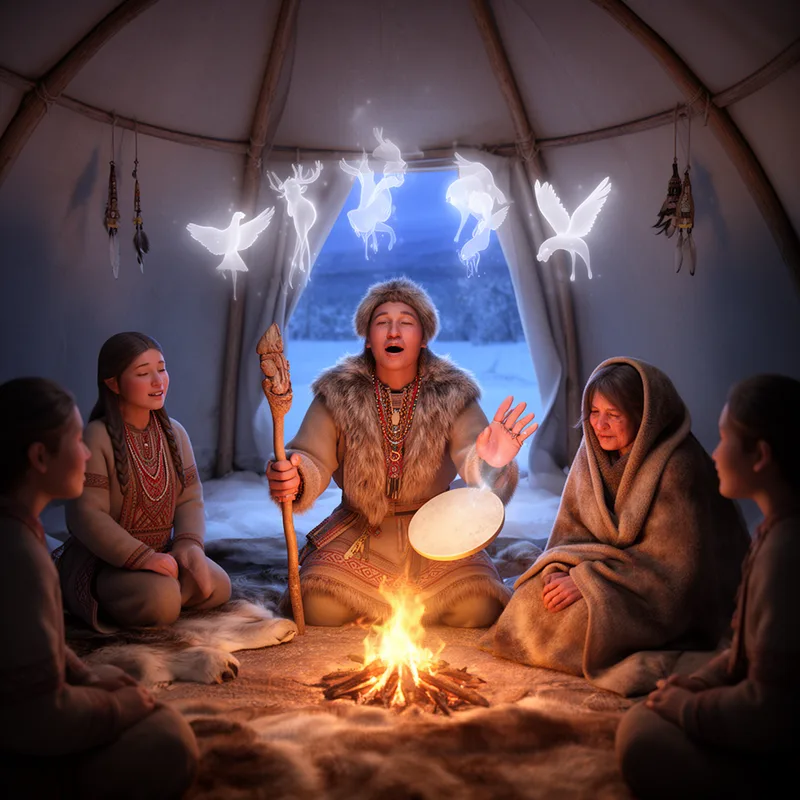
Asian shamanism
- noun
- The role of the shaman in Asian shamanism involves healing, divination, and communicating with spirits.
Examples
-
Scholars have studied the rituals and symbols of Asian shamanism to understand its influence on local traditions.
-
In Mongolia, Asian shamanism plays a vital role in cultural traditions.
-
Many indigenous communities still practice Asian shamanism as part of their cultural heritage.
-
Many tribes practice Asian shamanism to connect with their ancestors.
-
Many indigenous communities still practice Asian shamanism as part of their cultural heritage.
-
The role of a shaman in Asian shamanism includes healing, divination, and facilitating communication with spirits.
-
In Mongolia, Asian shamanism significantly influences cultural rituals and community bonding.
Synonyms
 2
8.5
2
8.5

A set of spiritual practices where a person connects with spirits to help people
Surface Forms
Morphology
The meaning is directly compositional: 'Asian' specifies the regional/continental domain and 'shamanism' names the belief system involving shamans, so a learner who knows both words can infer it refers to shamanistic practices in Asia. This is a straightforward adjectival modification rather than an idiomatic or metaphorical sense, and similar noun–modifier patterns occur cross-linguistically, making it transparent for B1 learners.
Etymology
The term Asian shamanism comes from the word shaman, a person who is thought to speak with the 'spirit world'. In many Asian communities a shaman would go into a trance to visit spirits and help or heal people, so Asian shamanism means the beliefs and ceremonies where shamans connect people with the 'spirit world'.