
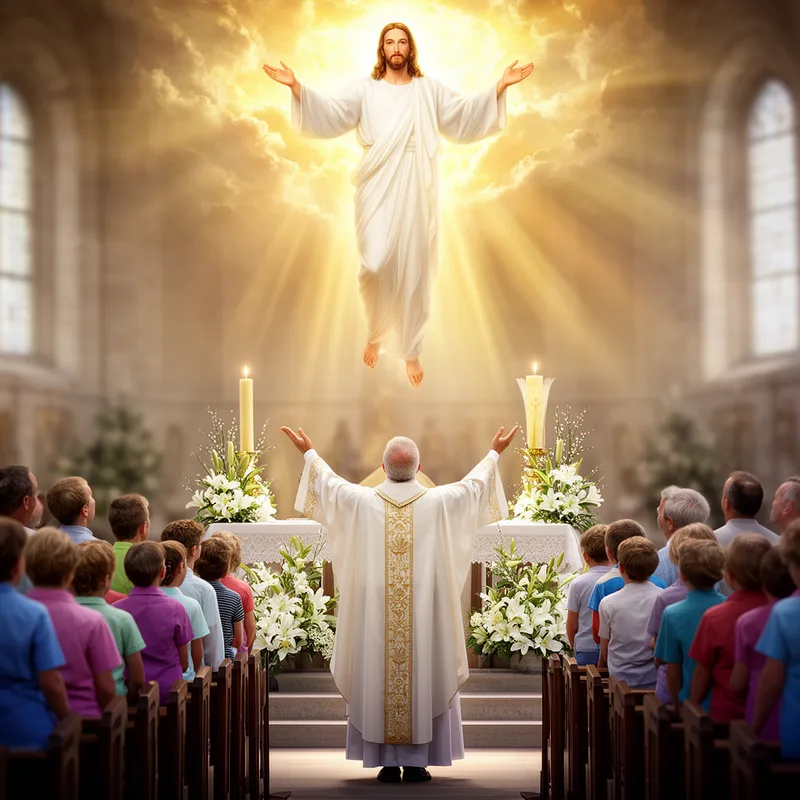
Ascension of the Lord
- noun
- On the 40th day after Easter, Christians celebrate the Ascension of the Lord, marking Jesus Christ's ascent into heaven.
Examples
-
Many churches hold special services to commemorate the Ascension of the Lord each year.
-
She established the monastery for men so that the monks might perform the laus perennis at the place of the Ascension of the Lord and in the grotto where the Saviour talked with his holy disciples about the end of time.
Academic text (2007) -
The Ascension of the Lord is a significant event in the Christian calendar, reflecting on the promise of Jesus returning.
Synonyms

 1
8.9
1
8.9

A Christian celebration forty days after Easter remembering Jesus rising into heaven


 1
6.5
1
6.5
A Christian holiday when people remember Jesus going up to heaven forty days after Easter
 1
6.7
1
6.7
An event when Jesus leaves Earth and goes up to heaven forty days after he comes back to life

A Christian belief about Jesus rising to heaven on the 40th day after he came back to life
Surface Forms
Morphology
The phrase is directly compositional: 'Ascension' denotes a rising into heaven and 'the Lord' refers to Jesus/God, so 'Ascension of the Lord' straightforwardly means the Lord's ascension. The liturgical detail (40th day after Easter) is cultural background but not necessary to derive the core meaning from the constituents, making it understandable to learners who know the component words.
Etymology
Ascension of the Lord comes from the Bible story where Ascension means going up and Lord refers to Jesus. In the story, Jesus is lifted up into the sky forty days after Easter and his friends watch him go 'to heaven', so the celebration remembers that event.