
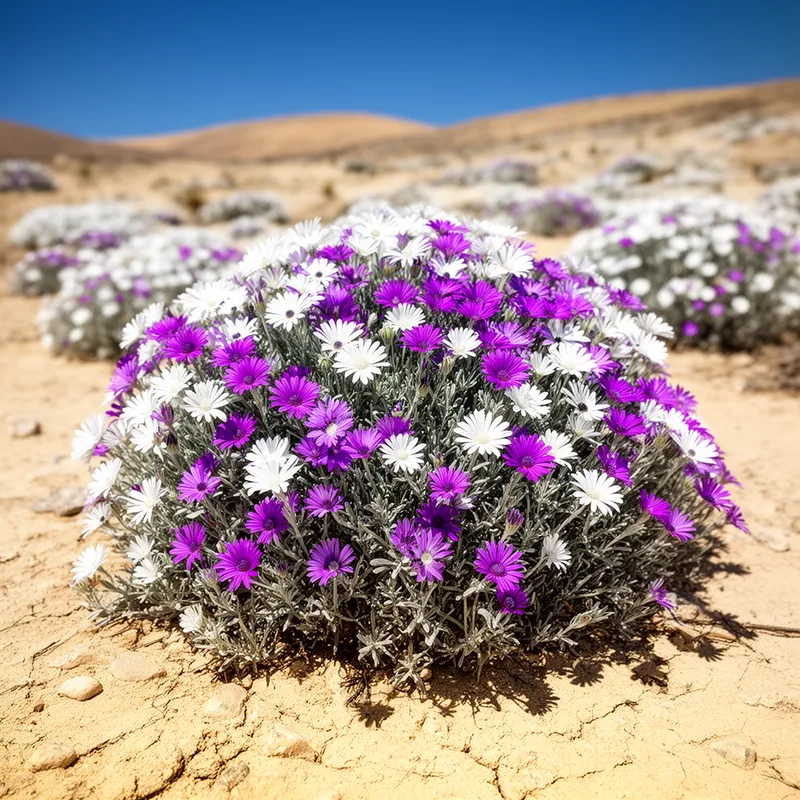
Arctotis stoechadifolia
- noun
- Specialized
- The hills were blanketed with blooming Arctotis stoechadifolia during spring.
Examples
-
Gardeners prize Arctotis stoechadifolia for its vibrant white and violet flowers.
-
Botanists study Arctotis stoechadifolia for its ability to thrive in dry, sandy soils.
-
The Arctotis stoechadifolia blooms beautifully in spring.
-
Have you seen an Arctotis stoechadifolia in the garden?
-
Many flower enthusiasts cultivate Arctotis stoechadifolia in their gardens for its stunning blossoms.
-
In spring, you can see fields of Arctotis stoechadifolia painting the landscape with vibrant colors.
-
The resilient Arctotis stoechadifolia is often used in landscaping for its drought resistance and beauty.
Synonyms

A bushy plant from South Africa with white or violet daisy-like flowers

A bushy plant that lives for many years and has white or violet flowers with blue centers
Surface Forms
Morphology
Arctotis + stoechadifolia
This is a Latin botanical binomial (genus + species epithet), not a compositional English phrase; the species epithet 'stoechadifolia' is not a dictionary word and conveys specialized taxonomic information. Even if a learner recognised 'Arctotis' as a plant genus, the full specific meaning (a particular species with certain features) cannot be derived from the constituents by a typical B1 learner without botanical knowledge.
Etymology
Arctotis stoechadifolia comes from old Greek and Latin words that describe its look. Arctotis may mean 'bear's ear' because some species have round, ear-like leaves, and stoechadifolia means 'leaves like stoechas', another plant. So the name gives a picture of the plant's leaf shape and helps you remember it.

