
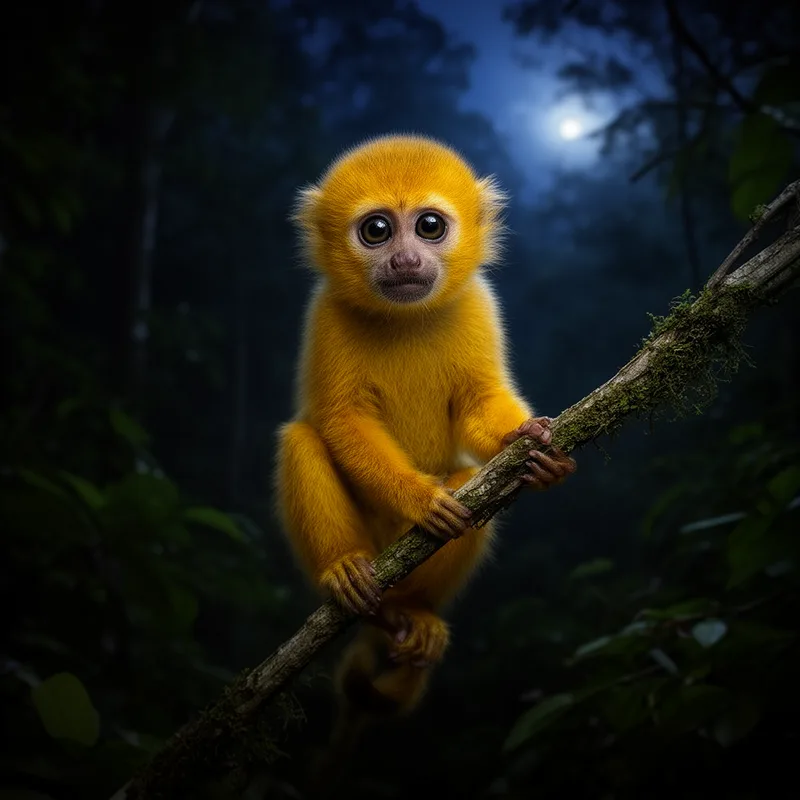
Arctocebus calabarensis
- noun
- Specialized
- The Arctocebus calabarensis is notable for its slow movements and nocturnal habits.
Examples
-
Unlike other primates, the Arctocebus calabarensis has a short tail and distinctive golden fur.
-
In the dense forests of Central Africa, the Arctocebus calabarensis primarily feeds on fruits and insects.
-
Researchers in Cameroon recently spotted an Arctocebus calabarensis in the wild.
-
The Arctocebus calabarensis is a unique species of primate.
-
Did you know that the Arctocebus calabarensis is nocturnal?
-
The Arctocebus calabarensis is known for its large eyes, which help it see in the dark.
-
Many researchers are studying the Arctocebus calabarensis to learn more about its behavior and habitat.
Synonyms

A small monkey that lives in trees in West Africa with yellow or golden fur

A small yellowish animal from West African forests that is active at night and eats insects and fruit
Surface Forms
Morphology
Arctocebus + calabarensis
The phrase is a Latin binomial combining a genus name (Arctocebus, a nocturnal African primate) with a specific epithet, so a learner who knows the genus could infer it refers to a species of that primate. However, the epithet 'calabarensis' is non‑English and relies on taxonomic/Latin place‑name conventions (e.g. 'from Calabar'), which are not obvious to a B1 learner, making the compositional link only partly predictable.
Etymology
Arctocebus calabarensis comes from old Greek words and a place name: Arctocebus combines words that meant 'bear' and 'monkey', and calabarensis means 'from Calabar' in West Africa. So the name paints a picture of a small, bear-like monkey from Calabar, which fits this slow, golden animal that is active at night.

