
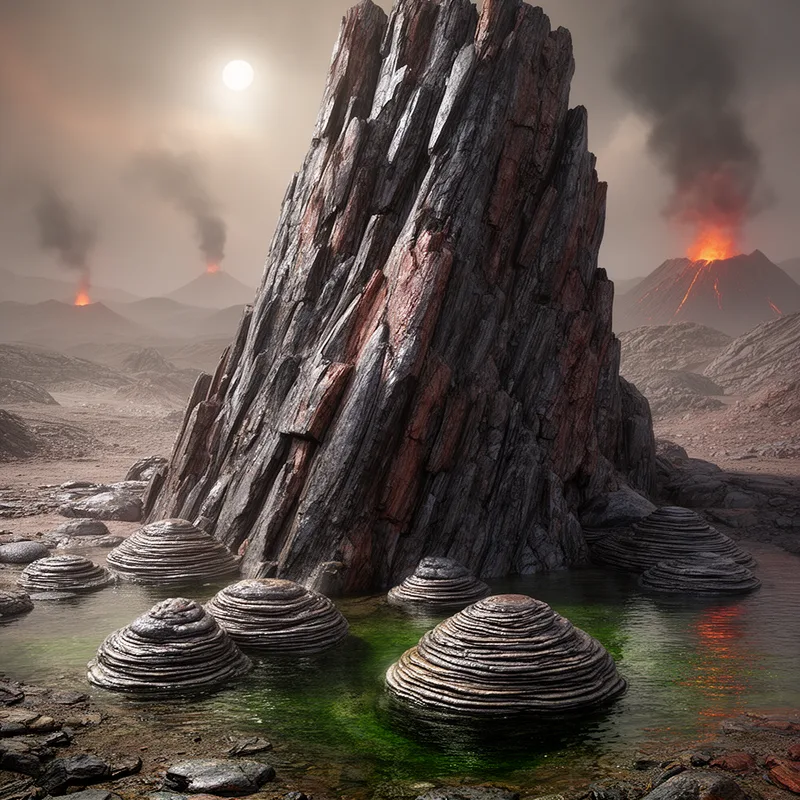
Archean
- adjective
- /ɑrˈkiːən/
- Specialized
- The Archean eon is characterized by the formation of the planet's first stable continental crust.
Examples
-
Scientists discovered fossils in Archean rocks that provide evidence of early life on Earth.
-
Early on, there were suspicions that the Archean carbon dioxide concentration was insufficient to counter the faint Sun.
Academic text (2006) -
Research into Archean geology has revealed important information about the conditions of early Earth.
Synonyms

The earliest part of Earth's history when the crust forms and simple life appears
Compounds

- Specialized
A time about 3.8 to 2.5 billion years ago when the Earth's crust formed and single-celled life began
Surface Forms
Morphology
Archean = arche + an
Formed from a Greek combining form plus '-an' to create an adjective referring to a specific geological eon or very old rocks; this specialized meaning is not transparently inferable by a B1 learner from the parts.
Etymology
Archean comes from the Greek archaios, meaning 'ancient', the same root you find in archaeology. That's why we call very old rocks and formations 'Archean'—they come from Earth's 'beginning' time.

