
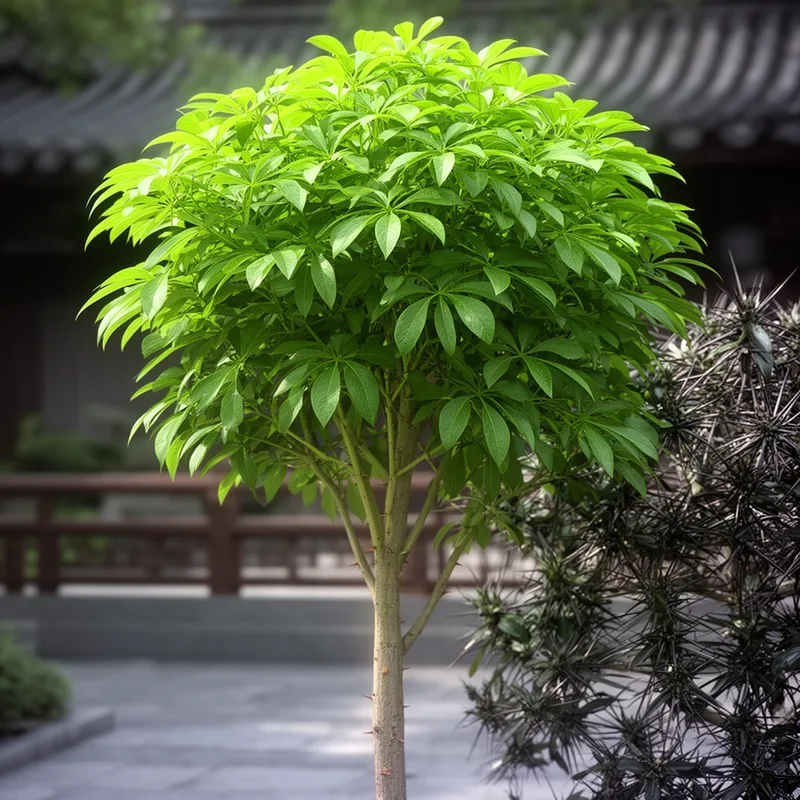
Aralia stipulata
- noun
- Specialized
- Compared to its American relative, Aralia stipulata has fewer and softer prickles on its stems.
Examples
-
Botanists discovered several specimens of Aralia stipulata thriving in eastern China.
-
The Aralia stipulata grows well in shaded gardens and requires little maintenance.
-
The Aralia stipulata is often found in the mountainous regions of China.
-
Many gardeners prefer Aralia stipulata for its unique appearance.
-
Many gardeners prefer Aralia stipulata due to its attractive green foliage.
-
The Aralia stipulata is often used in traditional Chinese medicine for its health benefits.
-
In late spring, the flowers of Aralia stipulata attract a variety of pollinators.
Synonyms

A small tree from China grown for its pretty flowers and used in medicine

A plant from China whose root is used in traditional medicine and cooking
Surface Forms
Morphology
aralia + stipulata
This is a Latin binomial: the first element 'Aralia' clearly signals a plant genus so a learner who knows 'aralia' can infer it names a type of that plant. However, 'stipulata' is a specialized Latin epithet (not a standard English word and not found in the provided dictionary) and denotes a technical botanical trait, so the full meaning is only partially transparent to a B1 learner.
Etymology
Aralia stipulata comes from the old plant group name Aralia and the word stipulata, which means 'with small leaf parts'. So the name paints a picture of a shrub in the Aralia family that has little parts at the base of its leaves, and that image helps you remember this species.

