
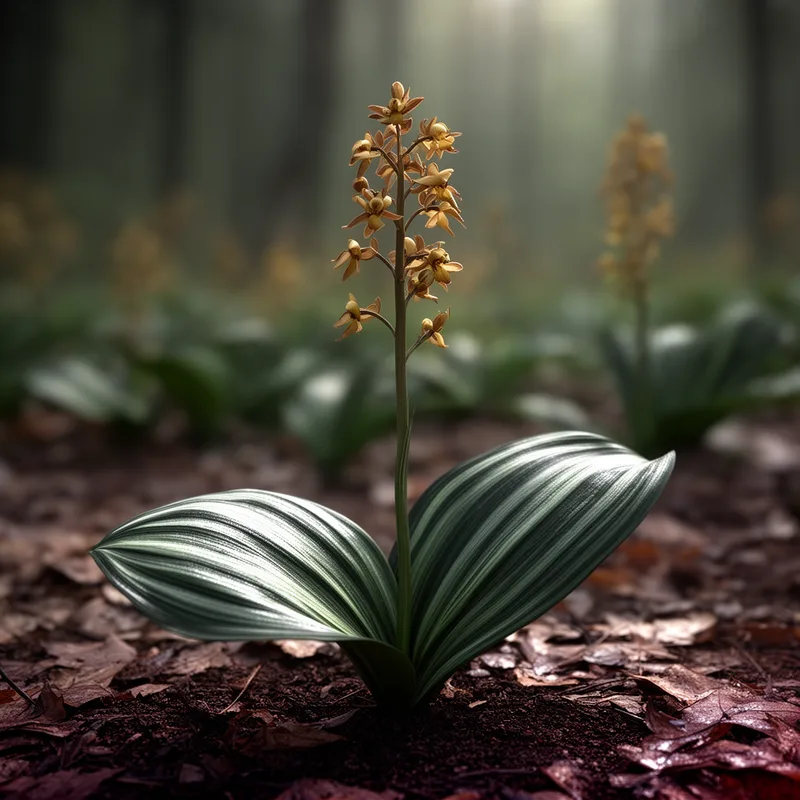
Aplectrum hyemale
- noun
- Specialized
 :
Aplectrum hyemale
:
Aplectrum hyemale
- Gardeners sometimes refer to Aplectrum hyemale as the putty root due to its sticky roots.
Examples
-
The shady woodland was dotted with blooming Aplectrum hyemale in early spring.
-
Botanists studied the distinctive leaf pattern of Aplectrum hyemale during their fieldwork.
-
I spotted an Aplectrum hyemale in the forest.
-
The Aplectrum hyemale blooms in early spring.
-
During a hike, we were excited to see several patches of blooming Aplectrum hyemale along the trail.
-
In her garden, she nurtured an Aplectrum hyemale, noting its unique yellowish-brown flowers.
-
The Aplectrum hyemale, commonly called putty root, thrives in shaded woodland areas.
Synonyms

A small North American orchid with one leaf and yellowish-brown flowers

A North American orchid with one leaf and yellow-brown flowers

A small North American orchid with a sticky underground root
Surface Forms
Morphology
Aplectrum + hyemale
This is a Latin binomial taxonomic name: a label made from a genus (Aplectrum) plus a species epithet (hyemale). Such scientific names function as arbitrary labels and the species epithet is not a common English word (not in the learner dictionary), so a B1 learner who 'knows' the parts would not be able to derive the meaning 'a North American orchid (putty root)'.
Etymology
The noun Aplectrum hyemale gets the common name putty root because its small, sticky underground roots look like pieces of putty. The second word, hyemale, is a Latin word meaning 'of winter', and that fits because the plant's single leaf and flowers appear in the cooler months, so the name points to both its sticky roots and its winter habit.

