
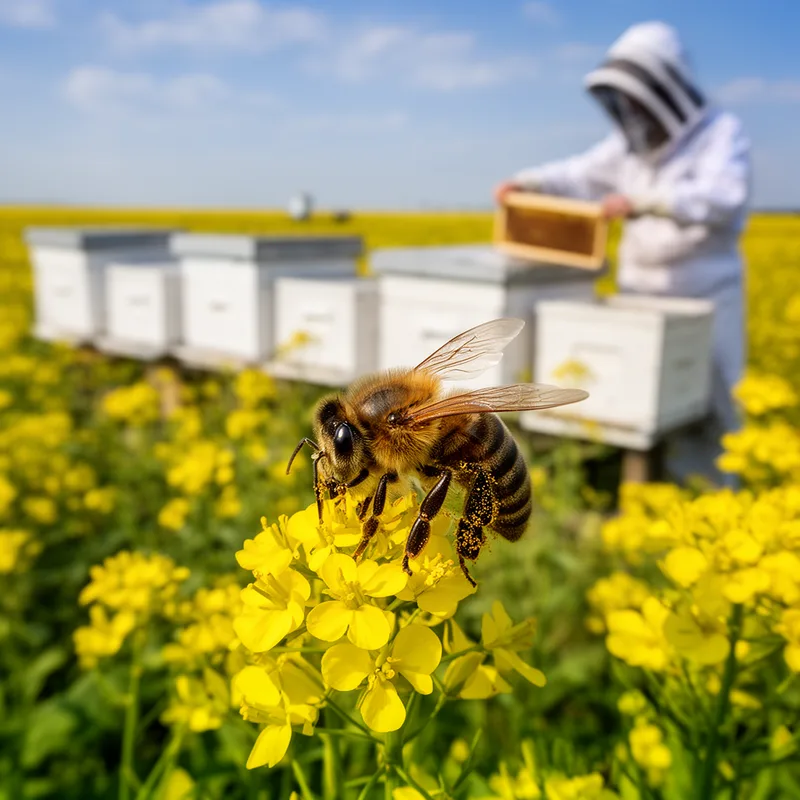
Apis mellifera
- noun
- /ˈeɪpɪs mɛlɪˈfɪrə/
- Specialized
- In gardens, Apis mellifera helps increase the yield of fruits and vegetables.
- Apis mellifera honey
- the Apis mellifera
- domesticated Apis mellifera
Examples
-
Farmers often rely on Apis mellifera to produce honey and ensure good harvests.
-
All of the honeybees we discuss in this article belong to the race Apis mellifera scutellata.
Academic text (1998) -
The vast majority of the subcontinent is populated by Apis mellifera scutellata.
Academic text (1998) -
Honey bees (Apis mellifera) function as a cooperating group of individuals (colonies) characterized by division of labor.
Academic text (2018) -
The domesticated honey bee, Apis mellifera, has always played a key role in handling that task at America's commercial cranberry farms.
Academic text (2000) -
The honeybees of Africa belong to the species Apis mellifera, which is subdivided into ten subspecies or races (Ruttner 1988).
Academic text (1998) -
Apis mellifera scutellata readily absconds, and beekeepers must constantly ensure that hives are in good condition to prevent the bees from moving on (Ngolofwana 1994).
Academic text (1998) -
The European honey bee, Apis mellifera, is essential for pollinating many crops.
Synonyms
 15
1.2
15
1.2

A flying insect that lives in large groups and makes honey
Surface Forms
Morphology
Apis + mellifera
This is a Latin scientific binomial rather than a productive English phrase: 'Apis' is a genus name and 'mellifera' is a Latin species epithet (not found in general dictionaries), so a B1 learner who only knows ordinary English words would not be able to derive 'western honey bee' from the parts. Interpreting it correctly requires specialist or Latin knowledge rather than ordinary compositional understanding, so it is not transparent to learners.
Etymology
Apis mellifera comes from Latin: Apis means 'bee' and mellifera literally means 'honey-bearing'. So the name is a simple memory hook: it points to the bee kept for 'honey' and for pollination.