

Anomia ephippium
- noun
- Specialized
- The distinctive notch in the right valve helps identify Anomia ephippium among similar bivalves.
Examples
-
Researchers discovered a colony of Anomia ephippium attached to the rocks along the shoreline.
-
The Anomia ephippium is often seen on rocky substrates.
-
In marine biology class, we studied the habitat preferences of Anomia ephippium.
-
Have you ever collected Anomia ephippium while snorkeling?
-
Marine ecologists often study Anomia ephippium because it plays a vital role in the coastal ecosystem.
-
During our field trip, we found a large number of Anomia ephippium attached to the submerged rocks in the tide pools.
-
The unique shell structure of Anomia ephippium makes it an interesting subject for research in marine biology.
Synonyms
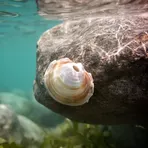
A sea animal with two thin shells, one side deeply notched, that clings to rocks
Surface Forms
Morphology
Anomia + ephippium
This is a Latin binomial (taxonomic) name rather than a compositional English phrase: 'Anomia' functions as a genus label and 'ephippium' is not a common English word (dictionary entry missing). Because the label is arbitrary and not built from everyday English morphemes whose meanings combine to give the species description, a B1 learner who knows the parts would not be able to infer the defined biological meaning.
Etymology
Anomia ephippium may come from old Greek and Latin words that describe its shell: Anomia suggests 'irregular' because these shells often sit at odd angles, and ephippium means 'saddle' because the right half of the shell has a deep notch that looks like a small saddle. That's why the name helps you picture this thin shell attached to rocks.

