
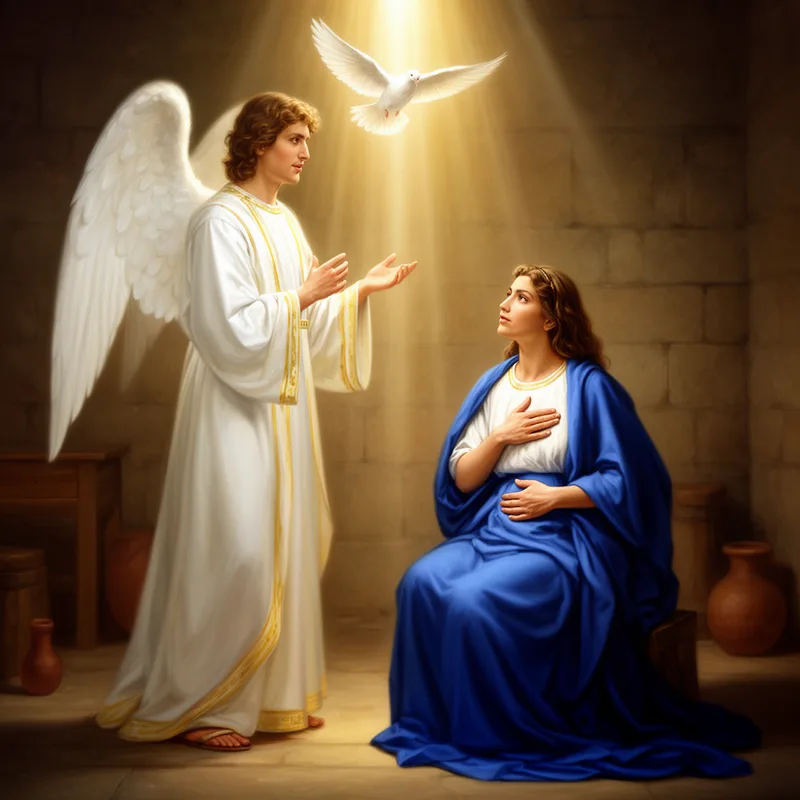
Annunciation


 1
9.9
1
9.9
- noun
- /əˌnʌn.siˈeɪ.ʃən/
- Formal
- This annunciation is the scene when Gabriel informs Mary that she will be the mother of God.
Examples
-
Many women read the subordinating Annunciation exegesis in Mariologies as uniquely directed to them.
Academic text (2005) -
They perform the Annunciation.
Fiction book (1999) -
Accessed September 9, 2017 at @longurl/annunciation
Academic text (2017) -
This Annunciation is different from most traditional depictions of this event because we don't see the angel.
Blog text (18) -
In the case of Fra Angelico's Annunciation, Hajdu
Blog text (18) -
Effects of fade-in and fade-out were constantly practiced by painters in various subjects, as, for example, in innumerable Annunciations.
Academic text (2007) -
By the speaking of the Declaration's word—as at the angel's annunciation to Mary—the country's parthenogenesis took place.
Academic text (1993) -
Initially titled "Mouthy Mary," it began as an exploration of how the annunciation might have proceeded had Mary not started spouting magnifcats but instead resisted the immaculate impregnation planned for her.
Academic text (2010) -
The profusion of clouds and angels in their productions is probably a direct response to similar elements in the unfinished Annunciation by Mengs that Carlos III ordered to be installed in the council room of the Madrid Academy in 1780 as an example to the professors and their students.
Academic text (1998) -
The Annunciation is celebrated on March 25, marking the moment when the angel Gabriel told Mary that she would give birth to Jesus.
Compounds

A Christian festival that remembers when the angel Gabriel told Mary she would have a son, held on March 25

Surface Forms
Morphology
Etymology
Annunciation comes from the Latin annuntiare, meaning 'to announce', and is from the same root as announce. It names the moment when the angel Gabriel 'announced' to Mary that she would become the mother of Jesus, so the word keeps the idea of a special announcement.