
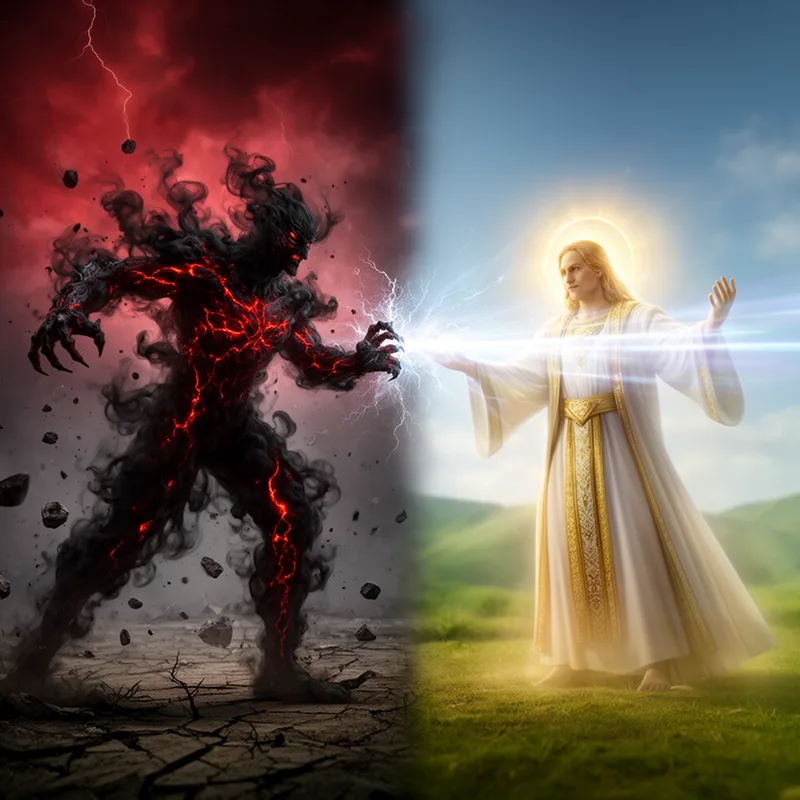
Angra Mainyu
- proper noun
- Literature
- Many Zoroastrian texts describe Angra Mainyu as the eternal adversary of Ahura Mazda.
Examples
-
In Zoroastrianism, Angra Mainyu embodies chaos and destruction.
-
The dualistic cosmology of Zoroastrianism centers on the struggle between Angra Mainyu and Ormazd.
-
According to the faith, Angra Mainyu represents all that is evil and destructive in the world.
-
Many followers fear Angra Mainyu as the source of all evil.
-
In Zoroastrianism, Angra Mainyu is viewed as the embodiment of chaos and evil against the goodness of Ahura Mazda.
-
The teachings of Zoroastrianism highlight Angra Mainyu as the arch-enemy of all that is good.
-
Many believers consider Angra Mainyu as the ultimate representation of malevolence in the cosmic battle of good versus evil.
Synonyms
 1
9.9
1
9.9

A spirit of evil in the ancient Persian religion that opposes the god of good
Surface Forms
Morphology
Angra + Mainyu
This is a culturally specific proper name from Avestan/Zoroastrian tradition whose constituents are not ordinary English words a B1 learner would know, so the meaning 'spirit of evil and chaos' cannot be compositionally derived. The sense is lexicalized and culturally bound rather than built from transparent English morphemes, making it unpredictable for learners.
Etymology
The name Angra Mainyu comes from an ancient language where angra meant 'destructive' and mainyu meant 'spirit' or 'mind'. So the name paints the picture of a harmful spirit, which is why it refers to the evil, chaotic force who opposes Ahura Mazda in Zoroastrian belief.