
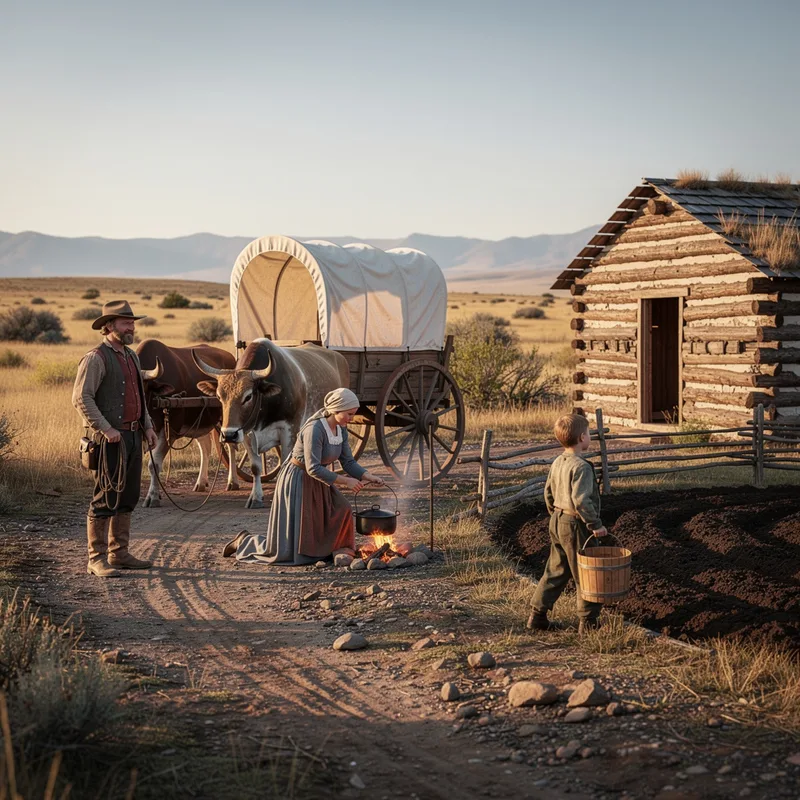
American frontier
 2
6.5
2
6.5

- noun
- /əˈmɛrɪkən frənˈtɪr/
- US
- Many families moved west to settle on the American frontier during the 1800s.
- the North American frontier
Examples
-
By the 1890s, when Heye began, the American frontier was declared officially closed.
Academic text (2006) -
Prosperity at the North American frontier was reflected in the vibrant financial and wholesaling functions of boom towns.
Academic text (2000) -
That there is no longer an American frontier.
-
And a large part of Pennsylvania was the American frontier for for decades.
-
This genre, set in the American frontier, was once huge.
Academic text (2010) -
This was the American frontier in 1882.
-
Western World is a complete re-creation of the American frontier of 1880.
-
I carefully choose examples to introduce the variety of experiences the Irish had on the nineteenth-century American frontier.
Academic text (2002) -
Some of the small tins of oysters even found their way into the far western American frontier by the 1840s and 1850s.
Academic text (1996) -
More than a century ago, the historian Frederick Turner argued that the closing of the American frontier—both the real frontier and, no less important, the myth of the frontier—marked the end of an epoch in the history of a new nation.
Academic text (1998)
Synonyms
 41
4.9
41
4.9
Land at the edge of settled areas next to wild land
 17
5.3
17
5.3
A time in the western United States when settlers moved in and there were few laws
Surface Forms
Morphology
The meaning is directly composed from 'American' (relating to the United States) + 'frontier' (land at the margin of settlement), so a learner who knows both words can infer it refers to the U.S. borderlands or unsettled western lands. The historical period detail (18th–19th centuries) is additional background but not required to derive the basic meaning, making the phrase straightforward for B1 learners.
Etymology
American frontier comes from the image of a moving line or edge called the frontier, where settled farms met wild land. As pioneers moved west, that edge became the western part of the United States, so the phrase came to mean that area and the years when people moved west.