
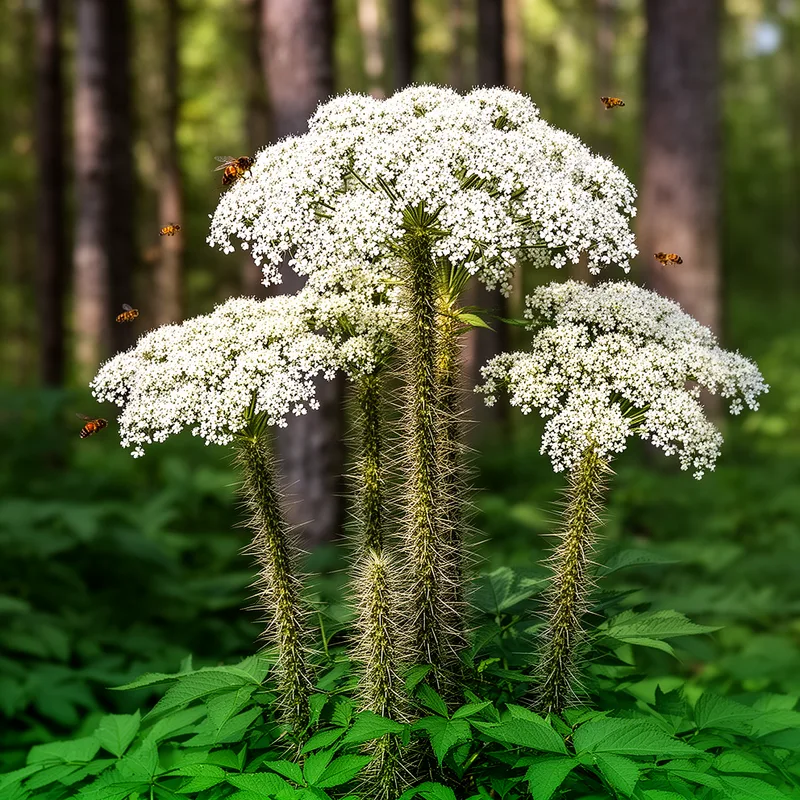
American angelica tree
- noun
- /əˈmɛrɪkən ˌeɪdʒəˈlɪkə tri/
- US
- Gardeners appreciate the American angelica tree for its striking white flower clusters in late summer.
Examples
-
Despite its thorns, the American angelica tree attracts many pollinators when in bloom.
-
The American angelica tree is often found along woodland edges in the southeastern United States.
-
The American angelica tree is often found in wetlands.
-
Have you seen an American angelica tree before?
-
The American angelica tree is known for its spiny stems and clusters of white flowers that bloom in summer.
-
Many wildlife species rely on the American angelica tree for shelter and food in their natural habitats.
-
In the eastern United States, the American angelica tree grows well in moist, wooded areas.
Synonyms

A small tree or bush in the eastern United States with large leaves and sharp thorns on its stems

A small tree or bush with spiny stems and large leaves
Surface Forms
Morphology
The phrase literally describes a tree that is an American variety of the plant 'angelica' — its meaning is directly built from 'American' (origin), 'angelica' (the plant), and 'tree' (a woody plant). This adjectival + noun + noun composition is fully compositional and follows standard naming patterns, so a B1 learner who knows the constituent words would readily infer the meaning.
Etymology
American angelica tree may get its name from the old herb angelica, a plant with white flower clusters that people long ago called 'angelic' because it looked beautiful and was used to heal. That's why a small, thorny plant with similar white flowers came to be called this, so today American angelica tree means the small, thorny shrub with clusters of white blooms.

