
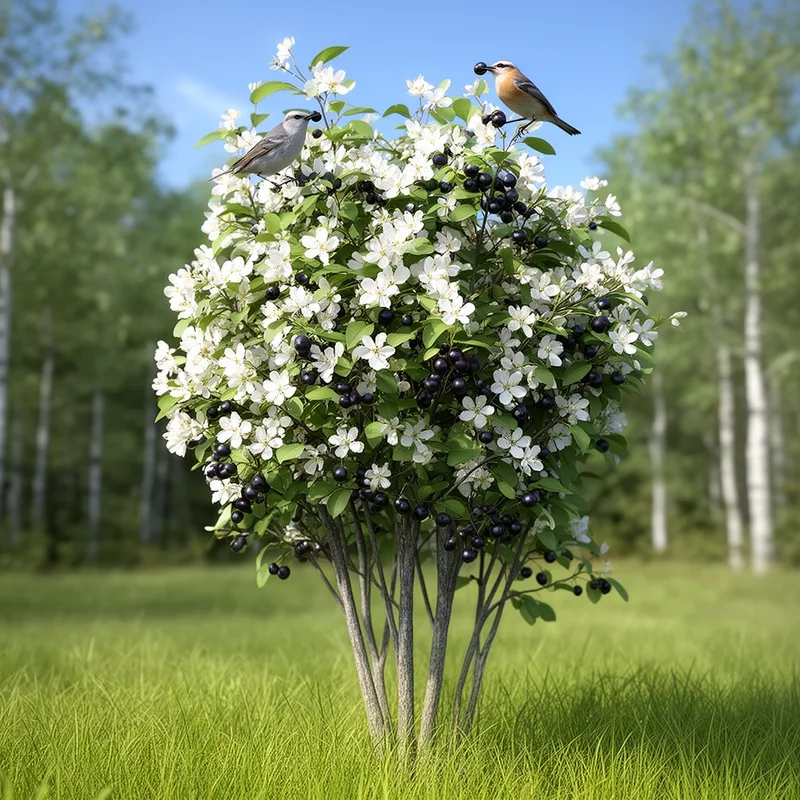
Amelanchier bartramiana
- noun
- Specialized
- The Amelanchier bartramiana produces white flowers that brighten the landscape in spring.
Examples
-
Berries produced by Amelanchier bartramiana are favored by many birds in eastern forests.
-
The Amelanchier bartramiana adds striking white blooms to the spring garden.
-
Botanists often study the Amelanchier bartramiana because of its unique dark fruit.
-
The Amelanchier bartramiana blooms beautifully in spring.
-
Many gardeners love Amelanchier bartramianas for their stunning flowers.
-
Gardeners appreciate the Amelanchier bartramiana for its edible black fruits that attract wildlife.
-
The Amelanchier bartramiana is a popular choice in eastern North American gardens due to its ornamental value.
Synonyms
A bush with white flowers and small dark berries
Surface Forms
Morphology
Amelanchier + bartramiana
This is a botanical binomial: the first element 'Amelanchier' identifies the genus (a type of shrub), so a learner who knows that constituent can infer this is a species of that shrub. However 'bartramiana' is an uninterpretable Latin epithet (likely commemorative) with no lexical meaning for a B1 learner, and understanding species-naming conventions is specialized knowledge. Because part of the meaning (the taxon is a kind of Amelanchier) is derivable but the specific epithet and detailed sense are not, the item is only partially transparent.
Etymology
Amelanchier bartramiana likely comes from the genus Amelanchier, a group of shrubs with white flowers and dark berries, and the species name bartramiana, which honors the plant collector William Bartram. So, the name points to this shrub's white blooms and small dark fruit and to the man who first studied it.

