
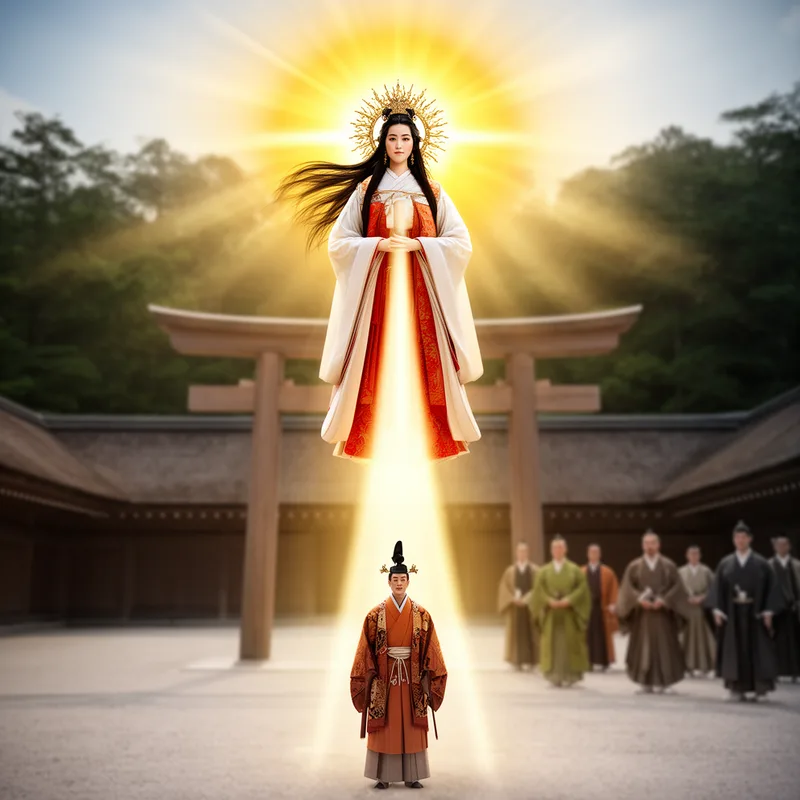
Amaterasu


 1
9.9
- proper noun
- Literature
- Only after the imperial system became established did the Sun Goddess (Amaterasu) become the deity addressed in the ritual (saishin).
- Amaterasu goddess
- Amaterasu sun goddess
Examples
-
In Shinto religion, Amaterasu is revered as the central sun goddess and the mythological ancestress of the Japanese imperial family.
-
Thanks to the original seeds given to him by Amaterasu, the grandson transforms a wilderness into a country with heavy ears of rice stalks (nzizuho) and abundant grains of the five types (gokoku).
Academic text (1991) -
Like Amaterasu in the myth, the emperor in the ritual goes into seclusion while his soul, detached and ready to depart from his body, returns and is rejuvenated.
Academic text (1991) -
The Japanese imperial system is often portrayed as a tradition characterized by a linear and absolute hierarchy, with Amaterasu at the top and her direct descendants, the divine kings, occupying the apex of Japanese society.
Academic text (1991) -
Shinto's supreme deity is the sun-goddess Amaterasu; rather than fostering an egalitarian matriarchy, however, she grounded the traditional Japanese hierarchy in her role as founding ancestor of the imperial family.
Academic text (1993) -
The Japanese believe that the sun goddess Amaterasu brings light and warmth to their lives.
-
Festivals celebrating Amaterasu often include rituals that honor her role in the creation of Japan.
Synonyms
A sun goddess who is central to Shinto and said to be the ancestor of Japan's emperors
Surface Forms
Etymology
Amaterasu comes from old Japanese parts ama meaning 'heaven' and terasu meaning 'to shine', so the name means 'shining in heaven'. That's why she is the sun goddess in Shinto and is seen as the ancestor of the imperial family.