

Amanita muscaria
- noun
- /əˈmænɪtə ˈmʌskəriə/
- Specialized
- Mushroom enthusiasts easily recognize Amanita muscaria by its distinctive white-spotted cap.
Examples
-
Despite its beauty, Amanita muscaria should never be eaten due to its poisonous properties.
-
The famous red-capped Amanita muscaria is often depicted in fairy tale illustrations.
-
The Amanita muscaria is often found in pine forests.
-
Many people admire the beauty of the Amanita muscaria.
-
Despite its beauty, Amanita muscaria should never be eaten due to its poisonous properties.
-
Many people admire the bright red cap and white spots of the Amanita muscaria in the forest.
-
Mushroom enthusiasts easily recognize the Amanita muscaria by its distinctive appearance and toxic nature.
Synonyms
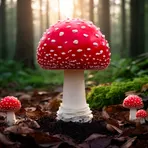
A poisonous mushroom with a bright red cap covered in white dots that grows in forests
Surface Forms
Morphology
Amanita + muscaria
This is a taxonomic binomial (genus + species). Knowing 'Amanita' lets a learner infer it is a species of the Amanita mushroom genus (often poisonous), but the specific descriptive meaning—bright red cap with white spots and the common identity as fly agaric—is not derivable from the species epithet 'muscaria' (which is not transparent to a B1 learner). Because learners can infer category but not the distinctive properties, the expression is only partially transparent.
Etymology
Amanita muscaria may get its name from two old ideas: Amanita from the Amanus hills and muscaria from the Latin word 'musca' meaning 'fly', because people once used pieces of the bright red, white-spotted mushroom to attract and kill flies. So the name links the mushroom's look and that old use, which helps explain why this poisonous red-capped mushroom is called Amanita muscaria.

